
Should I walk or run through rain to get less wet?

Answer

In still air, run. When it’s windy, move with the rain, not against it.

Over the same route in steady vertical rain, running does not increase the total amount striking your front. Running reduces the time available for rain to land on your head and shoulders.
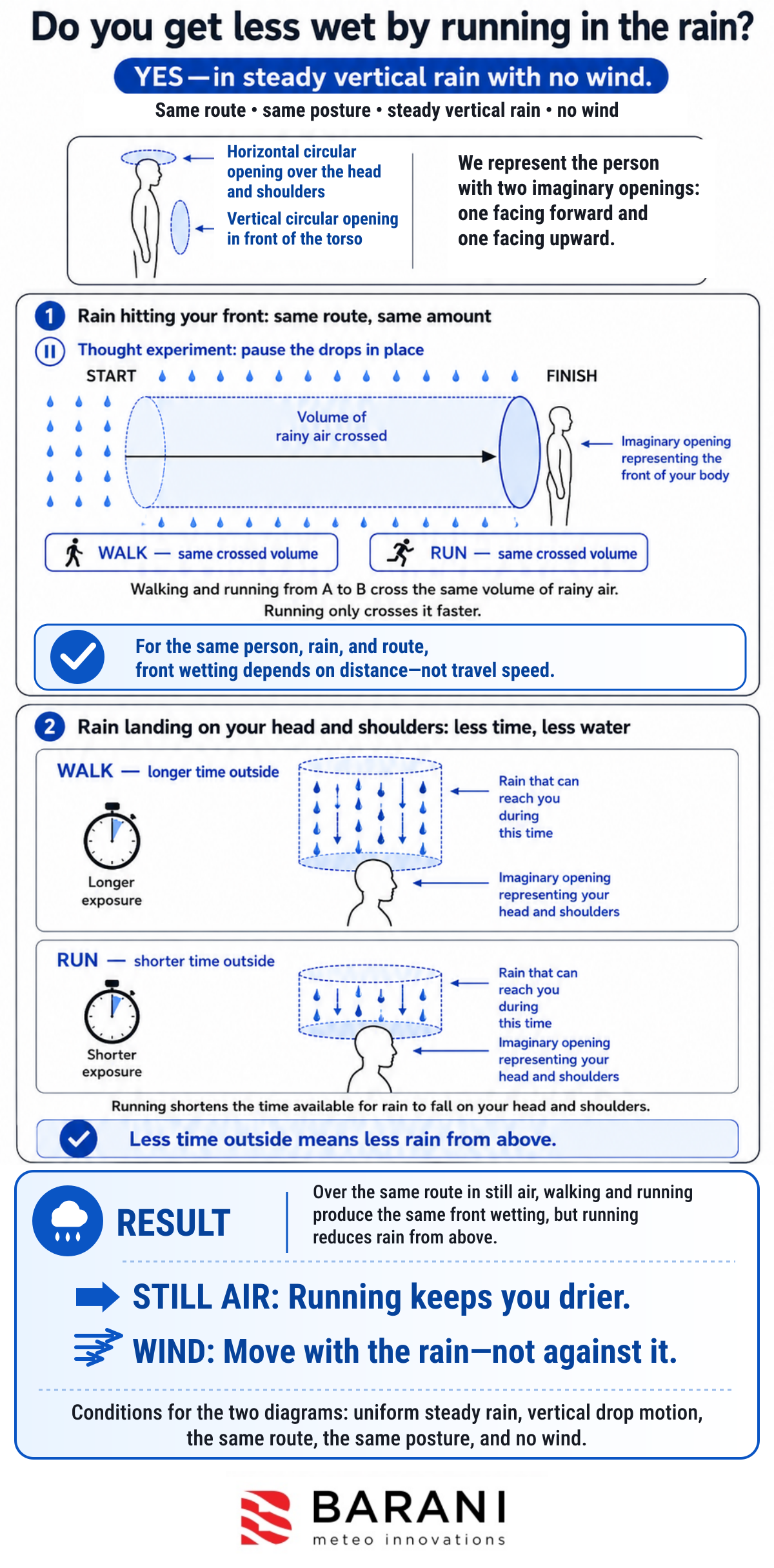
Illustration conditions: the same route, the same posture, uniform steady rain falling vertically, and no wind. Run only when the surface, visibility, traffic, weather, and your physical condition make running safe.
 
Infographic comparing walking and running through steady vertical rain. Both cross the same volume of rainy air at the front over the same route, while running spends less time in the rain and receives less rain from above.

Figure 1. In steady vertical rain with no wind, walking and running over the same route cross the same volume of rainy air at the front. Running shortens the time in the rain, so less rain lands on the head and shoulders. In wind, move with the rain’s sideways drift rather than against it.


Why running helps in still air

Rain hitting your front

Walking and running over the same route carry the front of your body through the same volume of rainy air. Running encounters that rain faster but completes the route in less time. The fixed-route total remains the same.

Rain falling from above

Rain continues falling on your head and shoulders for as long as you remain outside. Running shortens that exposure time, so less rain can land from above.

What changes when there is wind?

Wind changes the answer. A headwind adds rain at your front. A tailwind reduces front wetting and can shift the rain impact to your back when the rain’s sideways drift is faster than you. When your route allows, move in the same direction as the rain’s sideways drift rather than against it. Matching the rain’s sideways speed and direction removes the front-or-back contribution along your route. Running rather than walking shortens your time in the rain, so less rain lands from above.

In still air, run. When it’s windy, move with the rain, not against it.
Important limit: Real rain contains drops of different sizes, and gusts continually change their sideways motion. “Move with the rain” is therefore a practical direction rule—not one precise speed that can match every drop.

What else affects how wet you get?

This explanation counts direct rain striking your body. It does not predict exactly how much water clothing, hair, or shoes retain. Actual wetness also depends on posture, clothing absorption, runoff, evaporation, puddle splash, changing rainfall, turbulence, and nearby buildings or trees.

Safety comes first. Walk when wet pavement, poor visibility, traffic, lightning, ice, stairs, uneven ground, or your physical condition make running unsafe.
Bottom line: In still air, running reduces the rain from above without increasing the fixed-route amount striking your front. In wind, move with the rain rather than against it.

Conflict disclosure: Jan Barani is affiliated with BARANI DESIGN Technologies, a manufacturer of meteorological instruments. This person-wetting explanation is manufacturer-neutral and contains no product-performance claim.

Transparency Starts at the Sensor

Fix the instruments. Fix the forecast. Restore trust in climate warnings.

At MeteoExpo 2025 in Vienna, Jan Barani presented one of the most talked-about sessions at the Technology & Innovation Theatre — challenging the very foundations of today’s hydrometeorological measurement industry.

Our presentation, “Transparency Starts at the Sensor,” asks a simple but uncomfortable question:

How can we expect the world to trust our forecasts and climate warnings if the instruments we use to collect the data can’t be trusted themselves?

For too long, our industry has hidden behind laboratory certificates and “WMO-certified” marketing claims, while the quality of field measurements has quietly eroded.
From 3 °C temperature errors in official records to low-sampling ultrasonic anemometers that miss entire wind gusts, the credibility gap between data sheets and real-world truth is widening fastMET25_Technology & Innovation T…MET25_Technology & Innovation T….

Fix the Instruments, Not Just the Models

The presentation exposed how:

  • “All-in-one” weather sensors combine incompatible measurements that disturb the very air they’re trying to measureMET25_Technology & Innovation T….

  • Fan-aspirated radiation shields (FARS) distort measurement height and introduce thermal noise instead of removing itMET25_Technology & Innovation T….

  • Low-power ultrasonics with 1 Hz or slower sampling rates can’t capture a 3-second gust and yet are still accepted in automatic weather stationsMET25_Technology & Innovation T….

  • WMO’s own time-constant guidelines omit wind-speed context entirely, making the term meaningless in practical meteorologyMET25_Technology & Innovation T….

Rebuilding Credibility

If we want people to trust early warnings again, we must start with transparent instrumentation and open intercomparison testing.
The talk proposes a simple path forward:

  • Proposal to implement Continuous WMO intercomparisons open to all manufacturers, funded by HMEI fees— not invite-only.

  • Proposal to implement a wind-invariant constant and dimensionless response index to make temperature-sensor performance directly comparable across airspeeds.

  • A call for “WMO certification through transparency”, where every sensor is verified in field conditions, not just in a chamber of a calibration laboratory.

Download the Full Presentation

The full slide deck — complete with illustrations, caricatures, and technical appendices — is available here:
👉 Download the PDF Presentation

About the Author

Jan Barani, founder and CEO of BARANI DESIGN Technologies, has spent over two decades challenging conventional thinking in meteorological instrumentation. His innovations — from the MeteoShield Pro to the MeteoHelix IoT Pro — have redefined field measurement accuracy across the globe.

At MeteoExpo 2025, his message was clear:

“Forecasts graded by the public on outcomes, not on calibration certificates, deserve better inputs. Let’s fix the instruments first.”

BARANI DESIGN Technologies is a manufacturer of professional weather stations

Set-and-Forget Rain Gauge

Wireless MeteoRain IoT Compact is based on the MeteoRain 200 Compact rain gauge and offers users the freedom to collect rain measurements without having to install weather stations.

Measurement consistency, compact size, and its ability to measure even when not wholly level make the MeteoRain 200 Compact rain gauge a favorite for watershed monitoring, agriculture, and smart-city installations. Also available in a wireless version, this compact rain gauge not only features a standardized 200 cm2 measuring orifice area to WMO standards but does this in a very compact package whose installation is limited to just four screws.

Featuring a self-balancing, highly vibration-resistant measuring mechanism, it can provide consistent data quality for years on end. Additionally, long-term maintenance-free operation requires only a single re-calibration within 6-12 months of installation to account for soiling, after which it can operate with minimal measurement uncertainty for years.

This August in Chicago, BARANI DESIGN Technologies will be exhibiting and looking for B2B partnerships for the USA, Canada, and Mexico markets at the Meteorological Technology World Expo North America. This B2B expo will be at the Stephens Convention Center in Chicago on August 31 and September 1, 2022.

BARANI DESIGN Technologies s. r. o.
Klincova 35
821 08 Bratislava, SLOVAKIA
tel: +421 948 067 125
sales@baranidesign.com