
Smart-City Mistakes to Avoid: The Question of Big-Data vs. Accurate-Data

Smart-City Mistakes to avoid: quality of low-quality data sets does not improve as the data set gets bigger

Smart-City Mistakes to avoid: quality of low-quality data sets does not improve as the data set gets bigger

When sensor networks don’t meet basic standards of measurement, smart-city sensor networks become bottomless money pits. They can turn great ideas into senseless infrastructure and clouds of deceitful or meaningless data.

Early in the 21st-century, cities started experimenting with Smart-City projects as part of the fourth industrial revolution (Industry 4.0) even before the phrase Internet-of-Things (IoT) became popularized. Now, at the current peak of the IoT craze fueled by artificial intelligence and data-processing hype, the first signs of a need to meet basic measurement standards of NIST, WMO/CIMO, NWS/NOAA, ASTM and ISO are becoming apparent.

The clearest example of the need to meet basic measurement standards can be found in urban climate monitoring since cities pose a number of challenges to accurate air temperature measurement. Pavement and building walls in the vicinity of weather stations reflect and radiate solar energy much more than grass turf and from every direction onto a temperature sensor causing large errors of air temperature measurement. Since the distribution of errors in air temperature measurement is not symmetric around the real-temperature value and is unique for each weather station installation, practical experience has shown that the quality of low-quality data does not improve with data set size.

Quality of air temperature measurement can be easily assessed by plotting together sunshine intensity (W/m²) and air temperature (°C/°F). Low-quality air temperature sensors, together with cheap solar radiation shields, show an increase in air temperature of +0.5 °C (+1 °F) or more within a few minutes of the sun coming out from behind clouds or the weather station coming out of a shadow.

 
Manufacturer of high-quality and affordable meteorological solutions for Smart-City environmental sensor networks including the MeteoHelix IoT, MeteoRain IoT and MeteoWind IoT wireless weather station and sensors

Manufacturer of high-quality and affordable meteorological solutions for Smart-City environmental sensor networks including the MeteoHelix IoT, MeteoRain IoT and MeteoWind IoT wireless weather station and sensors

Can the MeteoWind® Compact turn the professional Wind Energy sensor market on its head?

MeteoWind® Compact anemometer meets measnet quality of measurement affordably

MeteoWind® Compact anemometer meets measnet quality of measurement affordably

With the launch of its latest iteration of the elliptic cup anemometer, the MeteoWind® Compact, BARANI DESIGN Technologies is poised to make another dent in the wind energy sensor market as dominated by Thies Clima, NRG, and Vector Instruments.

MeteoWind® Compact shares the proven robust cup design of its big brother MeteoWind® 2, thereby simplifying field service. It is the elliptic cup design which ensures MEASNET linearity [2] (Sample MEASNET calibration report) and enables MeteoWind® anemometers to excel not only in precision wind measurement for wind resource assessment but to also offer superb snow shedding for winter operation. A heated version of MeteoWind® Compact is also available.

  • As a direct replacement for NRG anemometers, the MeteoWind® Compact offers higher precision, requires less hardware to install since it offers wind speed and wind direction measurement in one compact device and is available at a better price point.

  • As an alternative to ultrasonic anemometers, MeteoWind® Compact offers higher precision and data reliability in bad weather and in winter. It is also bird damage resistant which is a major cause of ultrasonic anemometer failure. Every year, up to 30 % of ultrasonic anemometers are damaged by birds biting out their sound producing ultrasonic transducers. [1]

  • Compared to Thies 1st Class and Vector Instruments anemometers, it offers comparable if not better Class 1 precision and accuracy despite not yet having the MEASNET/IEC 61400-12-1:2017 EDITION 2.0 certification. Additionally, it also offers combined wind speed and wind direction measurement in one device, thereby simplifying installation.

For meteorological applications, MeteoWind® Compact offers significantly greater accuracy as required by the WMO and NWS [3], thereby making the anemometers maintenance free for many years after installation.

References

  1. Examination of different versions of bird repelling techniques for ultrasonic anemometers by K. Schubotz, H. Dörschel, Dr. E. Lanzinger, M. Theel of the German Meteorological Service.

  2. MeteoWind® Compact MEASNET calibration report

  3. MeteoWind® Compact 0 - 38 m/s calibration report

  4. MeteoWind® Compact anemometer datasheet

BARANI DESIGN TECHNOLOGIES IS A MANUFACTURER OF PROFESSIONAL WEATHER STATIONS AND METEOHELIX PERSONAL WEATHER STATIONS

BARANI DESIGN TECHNOLOGIES IS A MANUFACTURER OF PROFESSIONAL WEATHER STATIONS AND METEOHELIX PERSONAL WEATHER STATIONS

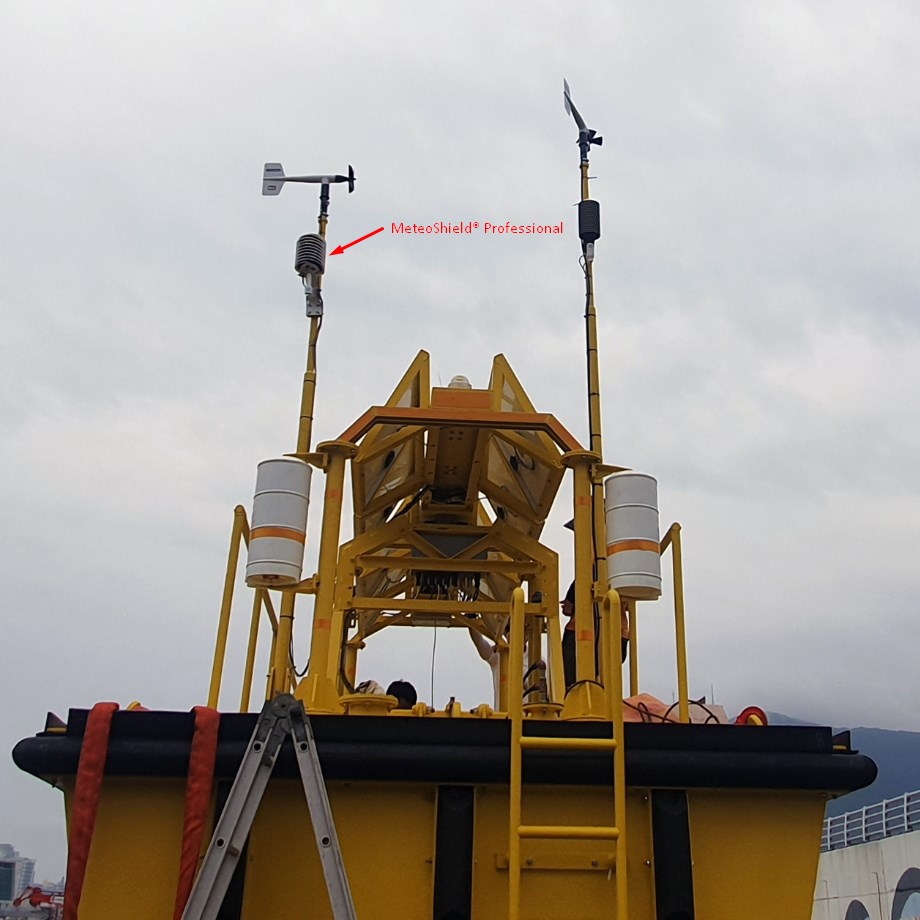
Innovative spiral design of the MeteoShield® Professional begins sea trials on buoys

Marine buoy radiative heating errors to be prevented by the helical MeteoShield® Professional

Marine buoy radiative heating errors to be prevented by the helical MeteoShield® Professional

MeteoShield® Professional begun sea borne testing on marine buoys in the Asia Pacific region last week. Compared to existing multi-plate solar radiation shield technologies and even fan-aspirated shields, it offers a significant improvement in all weather precision for air temperature and air humidity measurement. Compared to fan-aspirated shields, it has the added benefit of superior reliability.

This advantage in measurement precision is hoped to make a significant contribution to the quality of climatological measurements and is poised to increase confidence and precision in quantifying global warming and its associated climatic changes to the region.