

In what ways are the new BARANI rain gauges superior to current rain gauge designs?
/QUESTION: What makes the new MeteoRain 400 Aero & 533 Classic stand out among the meteorological and hydrological industry’s best rain gauges?
ANSWER: The main visible difference between the MeteoRain 400/533 rain gauges and the rest of the industry are the patented aerodynamic shapes.
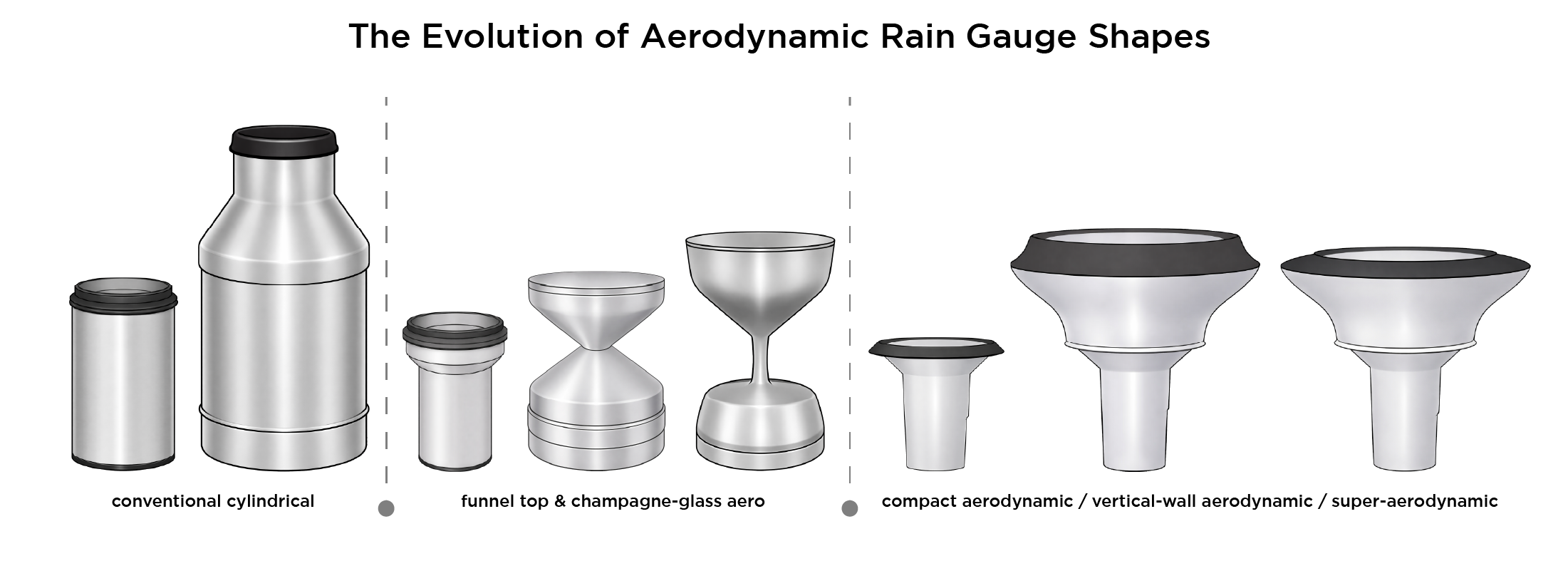
Since wind induced undercatch error is well documented as being the dominant error in rain measurement, rain gauge shapes have evolved over time to reduce the influence of wind on rain measurement.
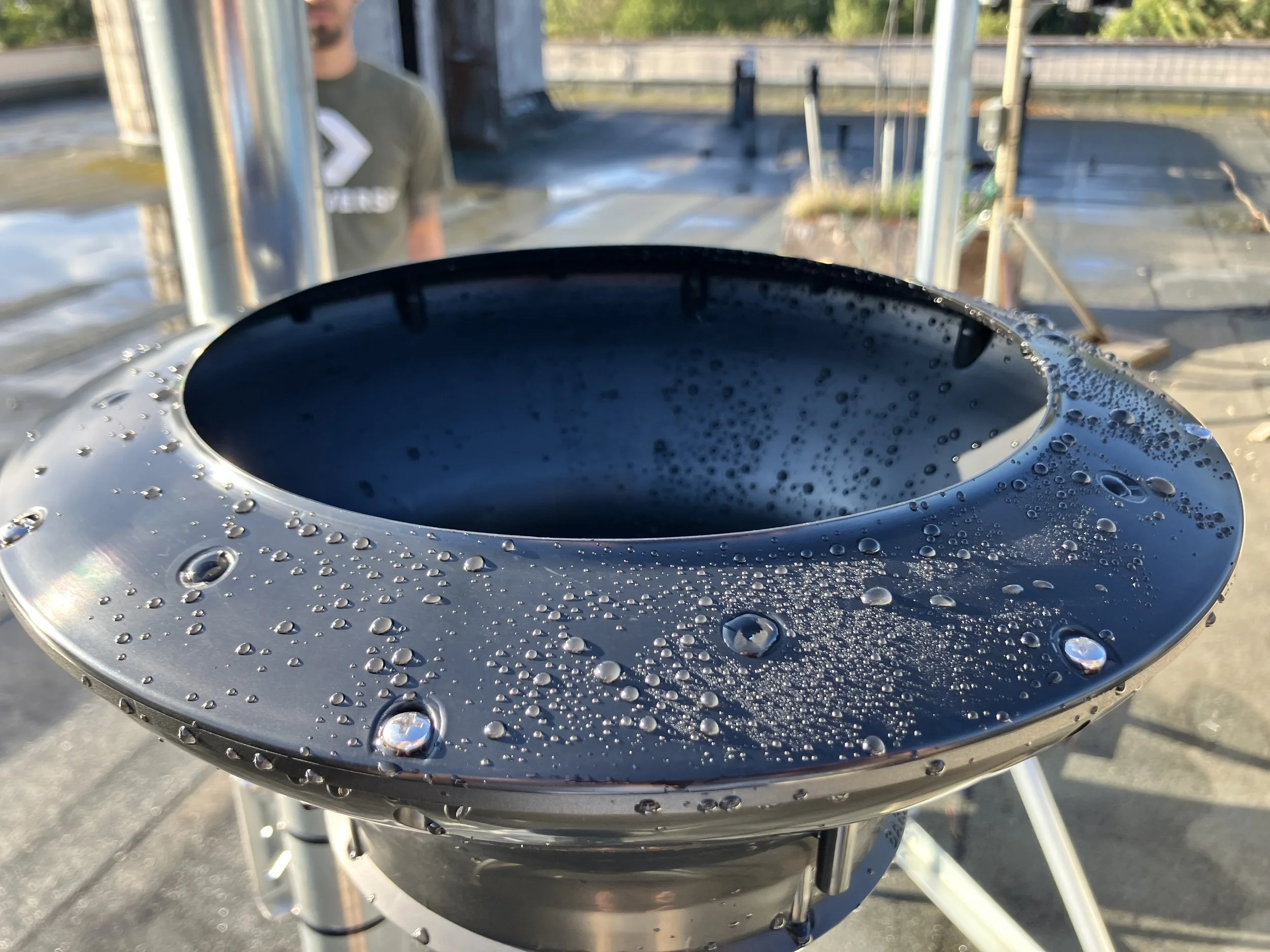
MeteoRain 400 Aero is a 0.1 mm resolution TBGR rain gauge with a patented super-aerodynamic splash guard funnel designed as a more accurate replacement to weighing rain gauge types.
Contributors to evaporation losses
Geometry / shading effect: A diverging-converging funnel reduces the fraction of wetted inner surface with direct sunlight. That is directly a major reduction in the evaporation surface area.
Color effect: For a fully wet cavity, since absorptivity for solar radiation is roughly α=0.20 for white and α=0.95 for black color, white minimizes the total absorbed solar energy and therefore the total solar-driven evaporation, even though internal reflections from white color also heat the shaded surfaces more broadly.
Material effect: With equivalent coloring, polypropylene minimizes heat transfer from the sun-warmed substrate into retained water because its thermal effusivity is much lower than stainless steel’s.
Effusivity effect: For retained water films on a rain-gauge funnel, the relevant material property linked to evaporation is thermal effusivity. Polypropylene has a much lower effusivity than stainless steel, so it transfers less heat to the water film on its surface, thereby reducing solar heat-driven evaporation. In the tables at the end of this article, the influence of surface color and solar absorptance is compared, which can dominate evaporative losses in direct sun due to differing solar heating. It must be noted that in direct sunlight, black surfaces heat up significantly more than white surfaces, but it must be noted that black shaded surfaces remain cooler than white colored rain gauges. This is because sunlight entering a white rain gauge is reflected off its inner surfaces, thereby heating the entire inner funnel.
They offer significant benefits in all areas of rain measurement since they directly address the so far unsolvable problems shared by the current status quo of rain gauge designs, including:
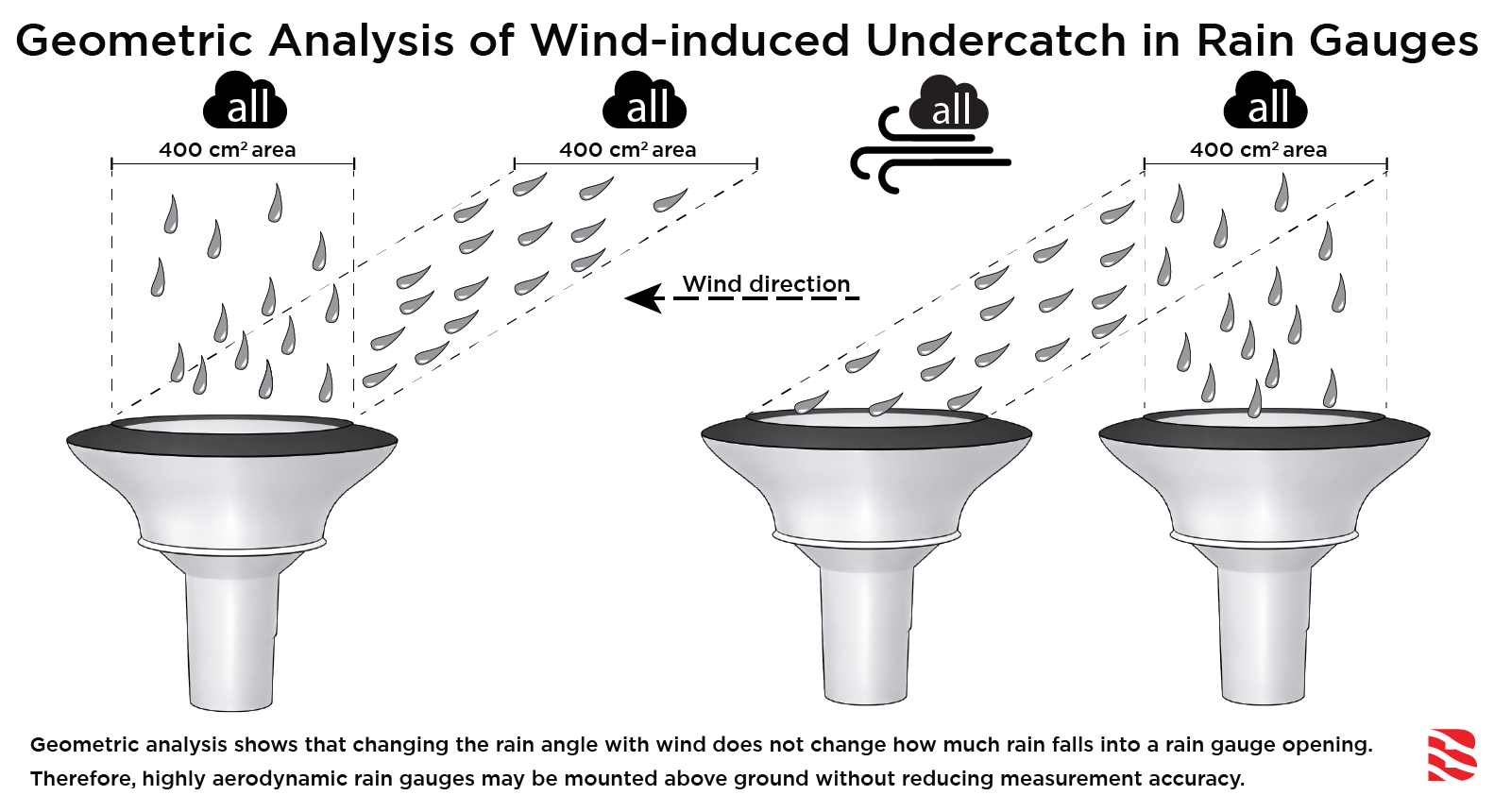
Wind-induced Undercatch (Exposure Error) - The MeteoRain 400 has significantly reduced the largest error source in rainfall and snow measurements. Until the MeteoRain 400 funnel was developed wind overspeeding past the rain gauge orifice was the largest source of error, masking other errors of rain measurement that are prevalent in many of the classical cylindrical and aerodynamic rain gauge designs. While the current generation of aerodynamic rain gauges slightly reduces wind undercatch, their open conical or champagne-glass funnel shapes significantly exacerbate water loss due to splash-out. MeteoRain 400 diverging-converging funnel solves both splash-out and wind-undercatch while overcoming structural weaknesses of classical barrel-shaped, open conical, or champagne-glass funnel shapes to provide a stable catchment orifice.
Evaporation losses - The MeteoRain diverging-converging funnel designs keep more of the inner funnel surfaces shaded by the upper lip from direct sunlight, thus reducing the heated surface area in contact with water. The choice of a plastic material with a 10+ year lifetime is deliberate due to its 17x lower thermal effusivity than stainless steel, which significantly reduces heat transfer to water and thus minimizes evaporative losses. In a wet rain-gauge funnel, two distinct effects must be separated. First, a white interior reflects part of the incident solar radiation, thereby reducing the total solar energy absorbed by the funnel surfaces and thus lowering total solar-driven evaporation. However, those internal reflections also distribute heating more broadly, so shaded inner surfaces in a white gauge receive more reflected energy than shaded surfaces in a black gauge. Second, at equal optical finish (color), polypropylene reduces evaporation relative to stainless steel because its much lower thermal effusivity transfers less heat from the sun-warmed walls into retained water films. A diverging-converging funnel geometry reduces evaporation further by keeping more wetted inner surface out of direct solar view. Overall effect of color on evaporative losses: Black-shaded surfaces are cooler than white-shaded surfaces, but a black funnel still loses more water overall in direct sun because it absorbs more of the incoming solar radiation.
Wetting (adhesion) Losses - Despite the larger wetted area of the inner funnel, by using a highly hydrophobic material with low surface energy and special surface texturing like plant leaves, the adhesion losses of water are minimized due to the high surface contact angle between 95° and 125°.
Gauge color and Thermal Effects - The two available MeteoRain designs are black or white with a black top, for hot climates. Due to the 17x lower thermal effusivity of the special-grade PP material, water heating is significantly reduced compared to metal rain gauge designs. Since the tipping bucket itself is made of a special material with very low thermal capacity and thermal conductivity, resulting in very low effusivity, it does not measurably contribute to volumetric and density changes due to water heating, thereby reducing tipping bucket errors.
Gauge inclination (Leveling) Error - Compared to a single-spoon or weighing rain gauge designs, a tipping bucket design has an inherent advantage of very low sensitivity to improper leveling in the longitudinal direction of the tipping bucket. The MeteoRain patented tipping bucket design significantly enhances this advantage over traditional tipping buckets, producing precise measurements even when not leveled in the transverse direction. This is due to the shape of the self-balancing tipping bucket, since transverse water distribution does not affect the longitudinal tipping bucket balance, unlike in traditional triangular tipping bucket designs.
Splash errors (Splash-in vs. Splash-out) - Splash-out has been significantly reduced by the MeteoRain 400 Aero due to the patented diverging-converging funnel as compared to any other aerodynamic rain gauge design. Splash-out for the MeteoRain 533 is also minimized. The splash-in for the MeteoRain 400 is minimal due to the curvature of the upper surface optimized for most splash to divert away from the orifice or if it exceeds the orifice lip, to fly over the orifice with the help of the wind. Splash-in is similar to a pit gauge, where the rain gauge orifice is at ground level.
Current industry standard outward-tapered aerodynamic rain gauge funnels optimize aerodynamics at the expense of splash-out; the diverging-converging funnel of the MeteoRain 400 Aero and 533 Classic solves both issues without having to make this compromise.
Wind-induced vibration error - Many professional rain gauges are very sensitive to wind-induced vibrations that generate longitudinal waves in the tipping bucket, leading to premature tipping due to changes in balance. The MeteoRain self-balancing tipping bucket has been designed with this in mind and minimizes this effect.
INDUSTRY NOTE: This vibration-induced tipping-point error is not tested during rain gauge calibrations and can lead to errors of up to 10% in triangular tipping-bucket designs. It may actually be hidden within the wind-induced (exposure error). It is also the major cause of phantom rain reports on windy days when, in fact, there was no rainfall.
Error due to soiling (sand, dust accumulation, or infrequent maintenance) - Soiling of a tipping bucket surface changes water's surface contact angle, thus changing the longitudinal distribution of water in the bucket over time, as residue of dust and dirt accumulates, it changes the tipping point balance primarily due to the change in the water distribution in the tipping bucket due to surface contact angle changes. The MeteoRain measurement mechanism has been designed to minimize this effect to the extent that uncertainty stays within the initial rain gauge uncertainty, even after years of maintenance-free use. BARANI rain gauges have been tested to remain within 3% of their initial calibration for 2 years without maintenance or cleaning prior to recalibration.
INDUSTRY NOTE: Often, measurement errors due to soiling of the measurement mechanism are a hidden effect, since rain gauges are usually cleaned before recalibration. We have not seen transparency from any other manufacturer, apart from BARANI, in quantifying errors caused by soiling of the measurement spoons.
Rain-intensity error - All MeteoRain rain gauges share a common tipping bucket. Currently, it has the fastest tipping-bucket speed on the market for Class-A precision up to 120 mm/hr rain rates, even without data logger correction for the MeteoRain 200, 60 mm/hr for the MeteoRain 400, and 40 mm/hr for the MeteoRain 533. These are fourfold improvements over any existing tipping-bucket rain gauge. MeteoRain pluviometers thus produce very low undercatch error at high rain intensities, on par with the best siphon gauges, as reported in “Which is more accurate: Siphon or a tipping bucket rain gauge?”
For example, the MeteoRain 200 undercatch is about 4x to 6x lower than any other 0.2mm rain intensity gauges on the market today. By adding simple linear data logger based intensity compensation based on inter-tip times, rain intensity error is easily eliminated. While siphon gauges have very high accumulation accuracy, unlike the MeteoRain series of pluviometers, they cannot be used to measure rain intensity because the timing of their tipping bucket tips is highly inconsistent due to siphoning.
Structural integrity, longevity, hail resistance - The 3D diverging-converging funnel design of the MeteoRain 400 and 533 is constructed of two parts bolted together by stainless steel bolts. The resultant 3D shell creates an extremely strong structure, as found in nature, thus maintaining its integrity under the most extreme wind conditions, high snow loads, and hail or debris impacts.
Technical notes for advanced users
304 stainless steel vs polypropylene properties in rain gauges as related to minimizing evaporation errors
- Steel stores ~2.6× more heat per area than PP
- Steel has ~17× higher effusivity than PP
Effusivity is the key factor for droplet heating:
Effusivity: $$ e = \sqrt{k \rho c_p} $$
Where:
- k = thermal conductivity of the rain gauge wall material
- $ \rho $ = density of the rain gauge wall material
- $ c_p $ = heat capacity of the rain gauge wall material
| Dry Rain Gauge Surface Temperatures in Direct Sun and Low Wind | ||
|---|---|---|
| Case | 60 s | Steady |
| White Steel | 26.6 °C | 28.7 °C |
| White PP | 27.8 °C | 28.7 °C |
| Black Steel | 32.8 °C | 43.3 °C |
| Black PP | 38.9 °C | 43.3 °C |
| Derived Thermal Properties of Stainless Steel (SS304) vs Polypropylene (PP) | |||
|---|---|---|---|
| Quantity | 304 SS | PP | Meaning |
| Volumetric Heat Capacity (MJ/m³·K) | 4.02 | 1.56 | Heat stored per volume |
| Areal Heat Capacity (J/m²·K) | 4015 | 1563 | Heating/cooling speed |
| Thermal Diffusivity (m²/s) | 4.03e-6 | 8.76e-8 | Heat spread rate |
| Thermal Effusivity | 8065 | 463 | Heat transfer to droplet |
| Material Propertiesof Stainless Steel (SS304) vs Polypropylene (PP) | ||
|---|---|---|
| Property | 304 Stainless Steel | Polypropylene |
| Density (kg/m³) | 8030 | 886 |
| Specific Heat (J/kg·K) | 500 | 1764 |
| Thermal Conductivity (W/m·K) | 16.2 | 0.137 |
Baseline environment used for calculations:
Ambient air temperature T∞ = 25°C
Relative humidity RH = 50% RH
Wind speed U = 1 m/s
Exposed plate size 10 × 10 cm²
Solar irradiance G = 1000 W/m²
Incidence angle 45°, so the surface sees G × cos(45°) = 707 W/m²
Equal wall thickness of 1 mm for the material-only comparison
Watch the shadows and sun shielding change as the sun (light) moves from east to west in this diverging-converging rain gauge funnel of the revolutionary super aerodynamic MeteoRain 400 Aero professional rain gauge.
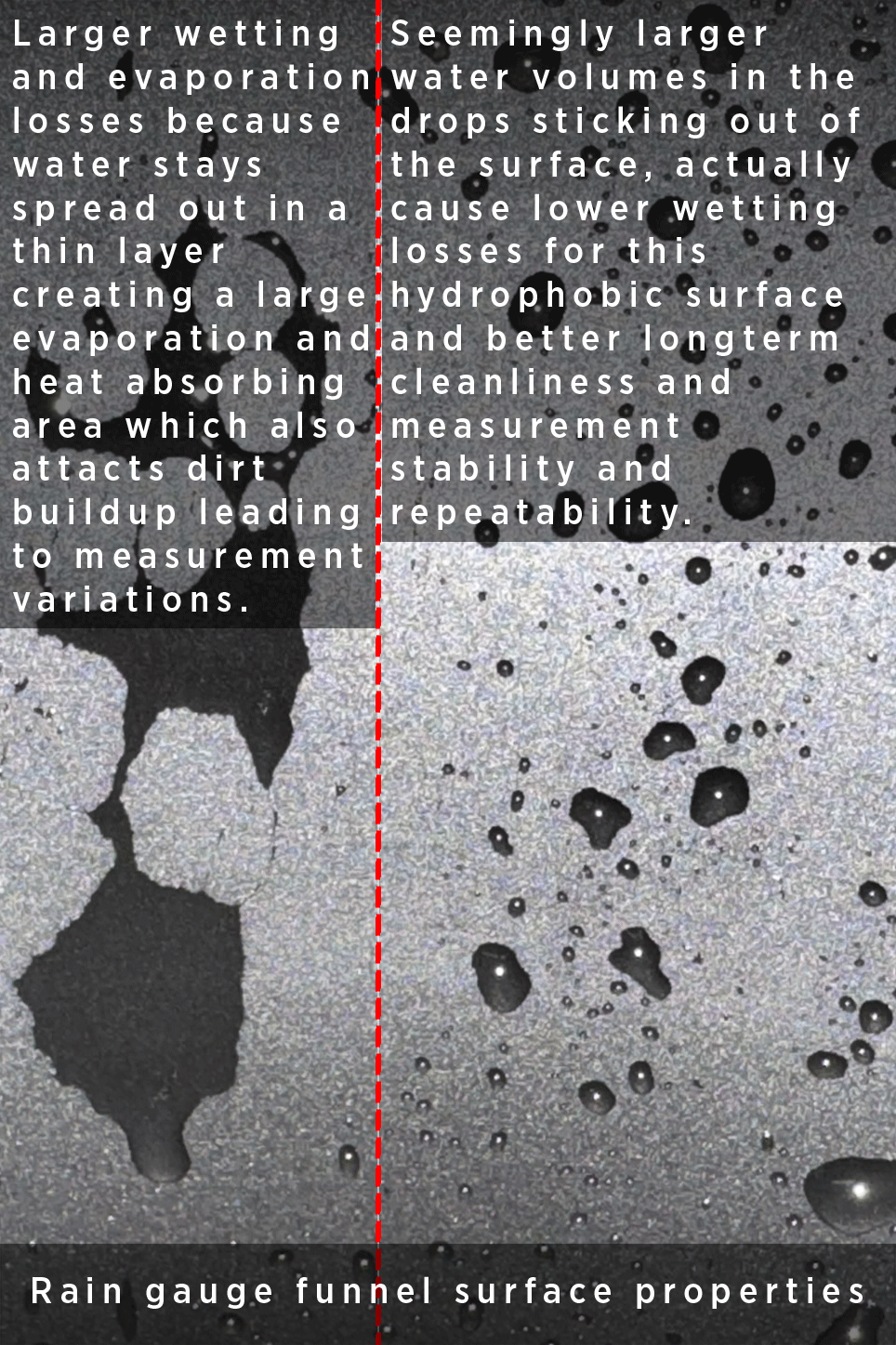
Rain gauge funnel surface properties comparison and retained surface water in relation to evaporation and wetting loses.
Parameters we can take from manufacturer datasheets/papers
Tipping bucket rain gauge (TBRG) (taken from MeteoRain 200 Pro, MeteoRain 400 Aero, MeteoRain 533 Classic)
Resolution: 0.2 mm MeteoRain 200 Pro (MR200), 0.1 mmMeteoRain 400 Aero (MR400), 0.075 mm MeteoRain 533 Classic (MR533)
Very fast self-emptying mechanism: tipping bucket speed 0.13 s (industry’s fastest to minimize errors)
Field performance spec: ±2%
Starting threshold: “Resolution + 0.07 mm” (and they explicitly discuss wetting/evaporation on funnel surfaces and sieve as part of this starting value)
Barani also states (for the “Pro” update) no-compensation performance up to ~100 mm/h, and maximum deviation −7% without compensation for MeteoRain 200 Pro at 600 mm/hr rain rate.
WRITER’S NOTE REFERENCE: One of the best articles that I found summarizing problems with rain measurement is
Tipping-bucket rain gauges: a review of the undercatch phenomenon, and methods for its reduction and correction. Weather, 80: 196-205. https://doi.org/10.1002/wea.7736 by Dunn, R.E., Fowler, H.J., Green, A.C. and Lewis, E. (2025).