

How does daily total solar radiation accuracy translate to instantaneous W/m² accuracy
/How "5% of daily total" solar radiation accuracy translates to instantaneous W/m² measurements
QUESTION: The MeteoHelix datasheet lists the solar radiation accuracy as "±5% of daily total." How does this specification relate to the individual instantaneous W/m² values that the sensor reports?
ANSWER: The short version: it does not translate to a fixed ± tolerance on each W/m² reading — and that is intentional.
If the sensor is a silicon-photodiode pyranometer or a photovoltaic PV solar-cell, its instantaneous error depends on things that change through the day: the sun's angle relative to the sensor (cosine / directional response), the spectral make-up of the light (direct sun vs. overcast vs. low sun near sunrise and sunset), and temperature. At a single instant — especially at low sun angles or in rapidly changing cloud — an individual W/m² reading can be off by more than 5%. These deviations are largely systematic and directional: they swing positive at some sun positions and negative at others.
Over a full day the sun sweeps across the whole sky, so those positive and negative deviations substantially cancel when you integrate all of the instantaneous readings into the day's energy sum. That integrated daily total (in Wh/m² or kWh/m²) is what lands within ±5%. The specification is written on the daily total precisely because that is the quantity that is well controlled; no meaningful fixed per-sample W/m² tolerance can be stated.
The unit link between the two
Daily total (Wh/m²) = the integral of instantaneous irradiance (W/m²) over the day. In practice, if you sum each 10-minute average W/m² value × (10 / 60 h), you get the day's Wh/m². Divide by 1000 for kWh/m².
Practical guidance: use the instantaneous W/m² values for trends, relative comparisons, and daily / seasonal energy — where the ±5% daily figure applies — rather than treating any single W/m² reading as accurate to a fixed tolerance.
Real-world validation: MeteoHelix vs. a reference spectroradiometer
An independent test by the University of Twente (ITC Faculty) compared a MeteoHelix silicon solar sensor against a co-located reference-grade spectroradiometer — a Spectral Evolution SR6500 — in an open grass field on 19 September 2025. Importantly, this was not a fresh lab sample: the MeteoHelix under test (serial 2412LH004) was manufactured in December 2024 and had been operating outdoors since February 2025 — roughly 7 months of field exposure, about 9 months from manufacture. Even after that weathering, the two instruments track one another closely across the whole range. The blue 30-second reference trace shows how quickly true irradiance swings during broken cloud, while the 10-minute values from both instruments stay in close agreement.
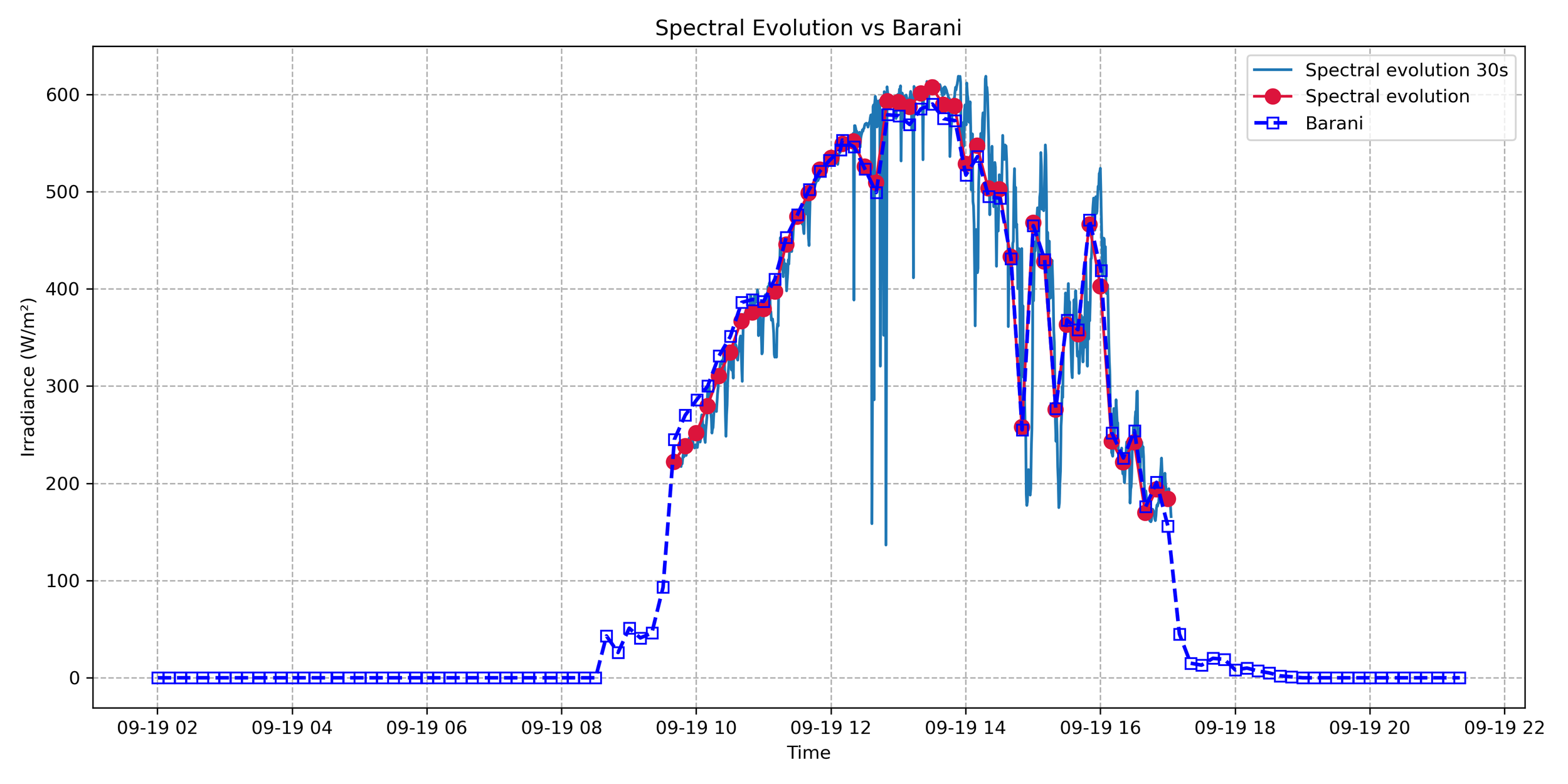
MeteoHelix (Barani) vs Spectral Evolution reference — irradiance time series over one day: Irradiance over one day (Sep 19 2025): MeteoHelix (Barani) vs. reference spectroradiometer 10-minute values, with the raw 30-second reference trace.
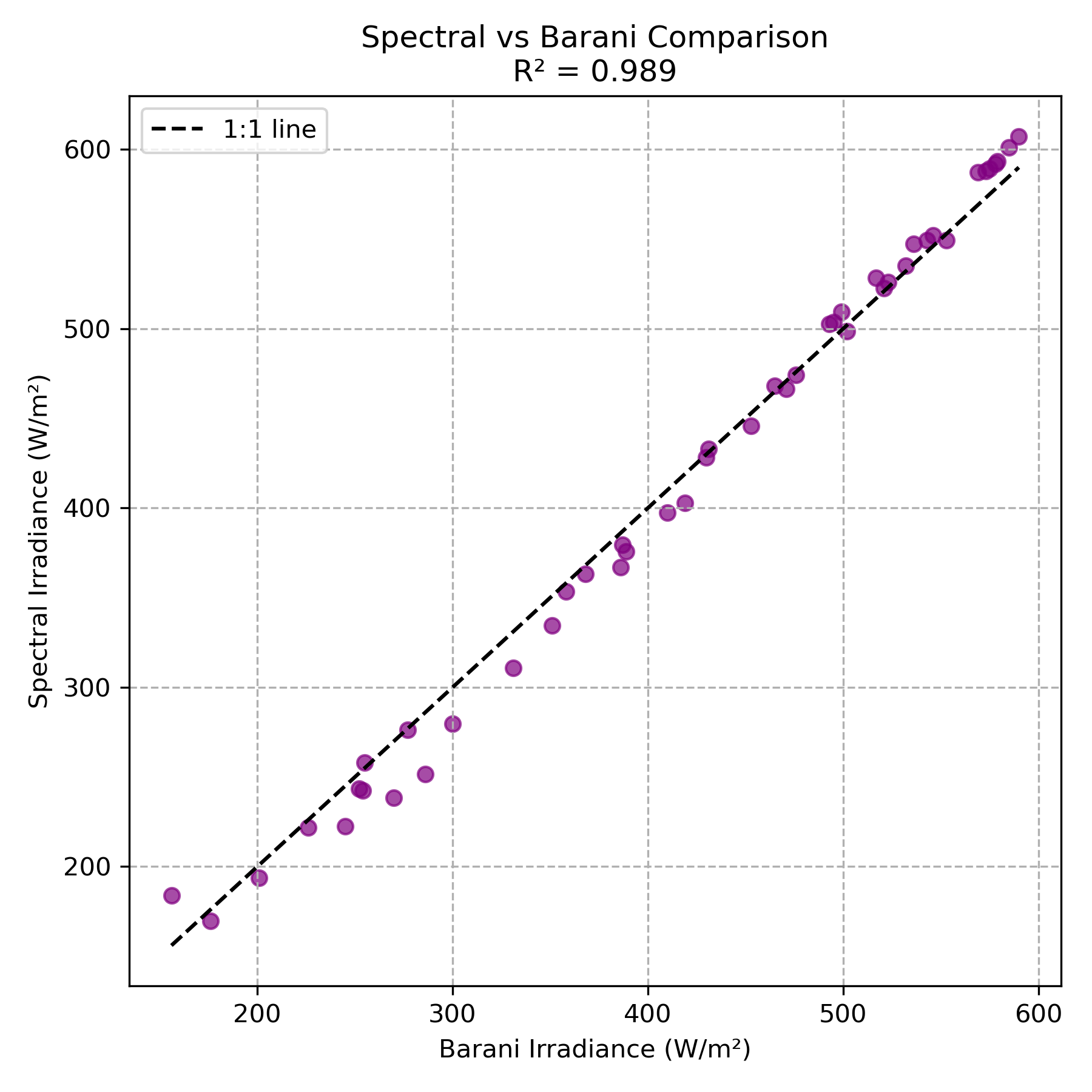
Scatter of MeteoHelix vs reference irradiance, R-squared 0.989, points on the 1:1 line: 10-minute paired values fall on the 1:1 line (R² ≈ 0.99).
The measured agreement, from 46 paired 10-minute samples, was:
- Correlation: R² ≈ 0.989, slope ≈ 1.0 — the two instruments are essentially interchangeable across 150–600 W/m².
- Instantaneous scatter: mean absolute difference of about 3% per 10-minute reading (a few W/m² of bias overall), exactly the kind of per-sample spread described above.
- Daily total: the integrated energy over the day matched the reference to within about 0.4% — far inside the ±5% specification.
This is the specification demonstrated in hardware — and on a real, field-weathered unit: after roughly 9 months (7 months outdoors), individual instantaneous readings still scatter by only a few percent, while the daily energy total agrees with a reference-grade spectroradiometer to a fraction of a percent, comfortably inside the ±5% specification.