

How to Certify Weather Data for Insurance Claims, Legal Disputes, and Court Proceedings
/Weather-data evidence FAQ
How to Certify Weather Data for Insurance Claims, Legal Disputes, and Court Proceedings
A practical framework for mesonets and weather-station networks in the United States and internationally, including federal archive records, operator affidavits, digital integrity, calibration, as-found testing, and expert interpretation.
Question
How can mesonet and weather-station data be certified for an insurance claim, legal dispute, or court proceeding?
Core answer. Weather data are not made scientifically reliable merely by notarizing a spreadsheet, and an instrument is not made legally admissible merely because its datasheet cites the World Meteorological Organization, the National Weather Service, the Environmental Protection Agency, or another standard. A defensible evidence package normally combines: (1) a qualified records witness; (2) an authenticated and integrity-protected data extract; (3) station, instrument, quality-control, and maintenance records; (4) independent as-found verification—testing before cleaning, adjustment, repair, component replacement, or firmware change—when the instrument itself is disputed; and (5) a qualified meteorological expert when the case requires interpretation, representativeness, uncertainty, or causation.
Where the United States federal archive fits. First determine whether the exact station record or product is maintained by the National Centers for Environmental Information (NCEI), part of the National Oceanic and Atmospheric Administration. The United States Department of Commerce can certify an authentic copy of an NCEI holding for legal use. That certification authenticates the archived record copy; it does not by itself establish field-sensor accuracy, local representativeness, or causation. If the relied-on record remains in a mesonet or private network’s own system, that operator must authenticate its native record and measurement foundation.
Legal and editorial note. This framework is educational and operational, not legal advice. No affidavit or certificate is automatically valid in every court or country. The factual core is designed to travel; the governing law, execution block, notice procedure, disclosure obligations, electronic-signature method, translation, and apostille or legalization requirements must be selected for the receiving forum.
Why this issue matters
A mesonet is a regional network of closely spaced automated weather stations used to observe local weather conditions at finer spatial resolution than a sparse national network. Mesonet and private weather-network observations are regularly requested for hail, wind, rainfall, flooding, freeze, heat, crop, construction, transport, aviation, liability, and property-insurance disputes. Most routine requests do not require dismantling a station. A well-controlled extract, a records-custodian declaration, and an adequate station dossier may be sufficient for the intended use. The strictest disputes arise when a party challenges the measurement system itself and the deployed instrument is preserved, removed without cleaning or adjustment, and independently examined in its as-found field condition.
That strict pathway changes the practical value of low-maintenance design. Laboratory accuracy on a clean, new instrument remains important, but a claim concerns the instrument that actually spent months or years in sun, rain, dust, salt, icing, insects, biological growth, vibration, condensation, and maintenance cycles. A design that reduces contamination, alignment changes, moving-part degradation, manual intervention, or undocumented service events may reduce evidentiary risk. It does not eliminate the need to document siting, exposure, data processing, maintenance, uncertainty, and chain of custody.
Weather networks commonly use one or more of the following operating models:
- a records custodian or other qualified person authenticates the network’s own records and describes the ordinary record system;
- a public climatological or records authority certifies records within its own legal or institutional scope;
- a federal or national archive provides a certified copy of a record held in that archive;
- the operator provides data and metadata without an expert opinion, while a qualified meteorologist performs the interpretation;
- an independent laboratory evaluates a disputed instrument in its preserved as-found condition; and
- the service is offered as a no-fee public function, cost recovery, a hybrid service, or referral-only according to the operator’s mission and resources.
The correct question is therefore not merely, “Can this network certify data?” It is: Which proposition must be proved, by which witness or institution, under which forum’s rules?
The six propositions that are often confused
| Proposition | What it establishes | Typical witness or source | What it does not establish by itself |
|---|---|---|---|
| Identity and authority | Who the signer is and why the signer may speak for the records | Records custodian, designated official, climatological authority, statutory or institutional authority | Scientific accuracy of every observation |
| Record authenticity | The attached file is what the network says it is and was kept through its ordinary system | Records custodian or another qualified person | Fitness for a particular accident site or causal opinion |
| Digital integrity | The delivered bytes have not changed since extraction | Signed manifest, 256-bit Secure Hash Algorithm (SHA-256) file hashes, controlled repository, system logs | Sensor calibration or site representativeness |
| Measurement foundation | How the station was sited, operated, calibrated, maintained, screened, and qualified | Network technical witness, records, calibration reports | Legal admissibility in every forum |
| Independent instrument verification | How the recovered instrument performed as received and, separately, after service | Competent calibration laboratory within the relevant scope | Proof that every historical observation was error-free |
| Meteorological interpretation | What the observations mean for time, place, uncertainty, exposure, and causation | Qualified forensic meteorologist or other expert | Authentication of records the expert did not maintain |
A robust package keeps these propositions separate. Asking one person to “certify the data as accurate and suitable for court” invites an avoidable challenge because the sentence may combine recordkeeping, metrology, representativeness, and legal conclusions.
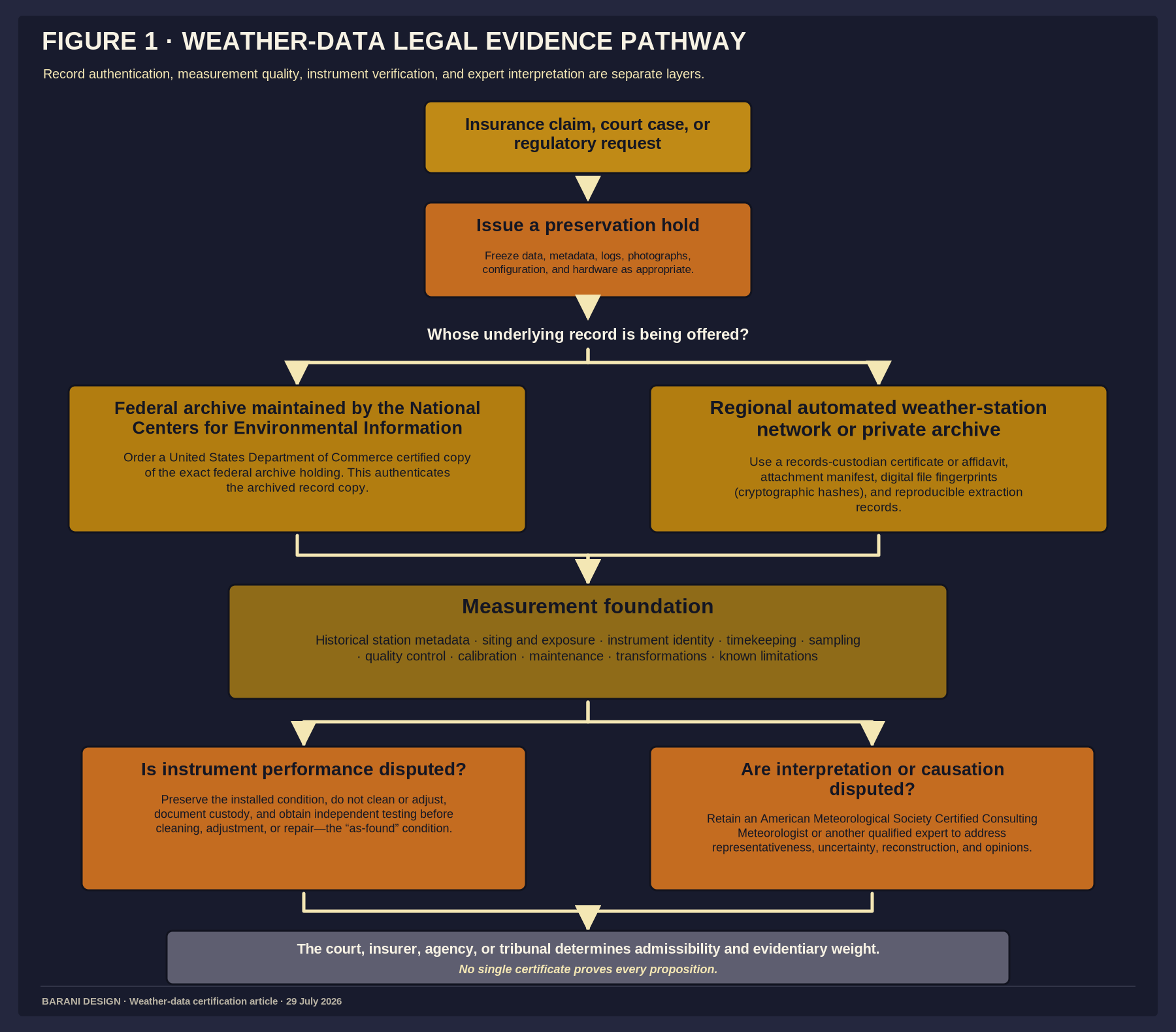
Decision map: which evidence path applies?
The first decision is the source of the underlying record. The National Centers for Environmental Information and a mesonet custodian may each authenticate records, but they authenticate different holdings. Measurement quality, instrument condition, and meteorological interpretation then require their own evidence.
What should a generic weather-data affidavit or declaration contain?
No single signature or notarization clause is valid in every jurisdiction. The factual core can nevertheless be made organization-neutral and country-neutral. The template should identify exactly who is speaking, which records are being authenticated, how those records were created and retained, what was delivered, what processing occurred, and what limitations remain. A lawyer or receiving authority then selects the execution form required for the particular court, agency, insurer, arbitration, or country.
| Foundation element | What the affidavit or declaration should state | Supporting material | Boundary to preserve |
|---|---|---|---|
| Signer and authority | Full identity, role, records responsibility, and factual basis for personal knowledge. | Job duties, written delegation, policy, statute, regulation, or official designation. | Authority to authenticate records is not automatically authority to give a scientific or legal opinion. |
| Organization and record system | Who operates the network and how observations are created or received, stored, retained, corrected, and exported in ordinary operations. | System description, retention policy, change-control record, and extraction log. | Do not imply that a later litigation export existed at the time of the weather event. |
| Station, period, and variables | Exact station identifiers, coordinates, requested date-time range, variables, units, data status, and attached files or pages. | Station schedule, variable dictionary, and exhibit index. | State whether the package contains source observations, summaries, images, metadata, or derived products. |
| Time and aggregation | Instrument sampling interval, archived record interval, delivered interval, statistic, timestamp meaning, time zone, daylight-saving treatment, and accumulation boundary. | Time and variable schedule. | A daily average calculated from five-minute observations is not the same product as the underlying five-minute observations. |
| Digital integrity | Extraction date, tool or query, exact file name, format, byte count, record count, and 256-bit Secure Hash Algorithm value. | Signed electronic-file manifest and retained master package. | A file fingerprint proves integrity from a defined point; it does not prove field-sensor accuracy. |
| Processing and corrections | Every conversion, aggregation, filter, rounding rule, correction, and derived calculation applied after acquisition. | Processing and transformation log. | Never label a processed product “raw” or omit a correction because it is inconvenient. |
| Measurement foundation | Supported facts concerning siting, exposure, calibration, verification, maintenance, quality control, outages, flags, and configuration changes. | Technical dossier and dated records. | Pre-deployment calibration is not a blanket statement that the instrument remained within tolerance throughout the disputed period. |
| Authentication and limitations | That the identified paper records and electronic files are authentic copies of the specified records, subject to stated completeness and status qualifications. | Signed certificate, schedules, and exhibits. | Do not state that the station represents another location, that weather caused a loss, or that admissibility is guaranteed unless a qualified person separately addresses those issues. |
| Execution | One sworn, unsworn, electronic, or jurisdiction-specific execution block approved for the receiving forum. | Signature, notarial certificate, seal, apostille, authentication, legalization, or certified translation where required. | Delete every unused execution alternative before signature. |
Separate sampling, archive, delivery, and statistic
One of the most common ambiguities is a statement such as “daily data from five-minute observations.” The affidavit should separately identify: (1) how often the instrument sampled; (2) how often the system stored or archived a record; (3) the interval delivered to the requester; and (4) the statistic or aggregation applied. Those four facts determine whether the exhibit contains source observations, averages, totals, maxima, minima, gusts, or another product.
State supported facts—not blanket accuracy
The records witness should describe documented calibration, maintenance, quality-control procedures, data status, and known limitations. The affidavit should not convert those facts into an unsupported conclusion that every observation was “accurate,” that the instrument was error-free, or that the station represents the disputed property. Those conclusions may require an independent laboratory, a site-specific analysis, or a qualified meteorological expert.
Download the generic Weather-Data Records Affidavit and Declaration Template
The editable Microsoft Word file contains a jurisdiction-neutral factual core, schedules for station identity, variables and time semantics, electronic file integrity, processing, calibration and maintenance, an exhibit index, alternative execution routes, and a final issuance checklist. It does not name or assume any particular mesonet, state, country, court, or insurer.
Frequently asked questions
1. What does it mean to “certify” mesonet data?
The word has at least four different meanings:
- Certified record or copy: a qualified person attests that the attached record is an authentic copy from the organization’s ordinary record system.
- Official archive certification: a public institution certifies a record held in its own archive under its authority.
- Calibration or test certificate: a laboratory reports a measurement result, method, uncertainty, conditions, and traceability for an instrument or system.
- Expert opinion: a qualified expert explains reliability, uncertainty, representativeness, or relevance to the disputed event.
A network should ask the requester which of these is required. A notary, custodian, laboratory, and meteorological expert perform different functions.
2. Who has authority to authenticate a network’s own records in the United States?
In United States federal practice, a records custodian or “another qualified person” may provide the foundation for records of a regularly conducted activity under Federal Rule of Evidence 803(6). Rule 902(11) provides a certification route for qualifying domestic records, subject to its notice requirements; Rule 902(12) addresses qualifying foreign records. Rule 901 provides the general authentication framework, while Rules 902(13) and 902(14) address certain electronic-process records and data copied from electronic devices, storage media, or files when authenticated by certification.
The witness need not be the technician who made every observation. The witness must be able to explain how the system ordinarily creates, receives, stores, preserves, and exports the records. State rules and administrative proceedings may differ, so the requesting lawyer should select the controlling procedure.
3. Does a records-custodian certificate prove the weather measurement was scientifically correct?
No. It primarily supports authenticity and regular recordkeeping. The opponent may still challenge trustworthiness, sensor condition, siting, calibration, time synchronization, missing data, quality-control processing, or representativeness. The measurement foundation should therefore be attached or made available rather than hidden inside a conclusory statement that the data are “high quality.”
4. What does a notary prove?
A notarial jurat generally establishes that the signer appeared, took an oath or affirmation, and signed as required. An acknowledgment generally verifies the signer’s identity and acknowledgment of execution. The notary does not determine whether the mesonet is scientifically competent, whether the station met a standard, whether the data are accurate, or whether the evidence is admissible. Those propositions require the appropriate records, technical witness, expert, or legal authority.
5. Can an unsworn declaration be used instead of notarization?
Sometimes. For matters governed by United States federal law, section 1746 of title 28 of the United States Code permits specified unsworn declarations under penalty of perjury. A state court, agency, insurer, foreign tribunal, contract, subpoena, or certification rule may require a different form. Use the execution option selected by counsel for the receiving forum; do not assume that a federal declaration automatically replaces every state or foreign notarization requirement.
6. How does the National Centers for Environmental Information fit into weather-data certification in the United States and internationally?
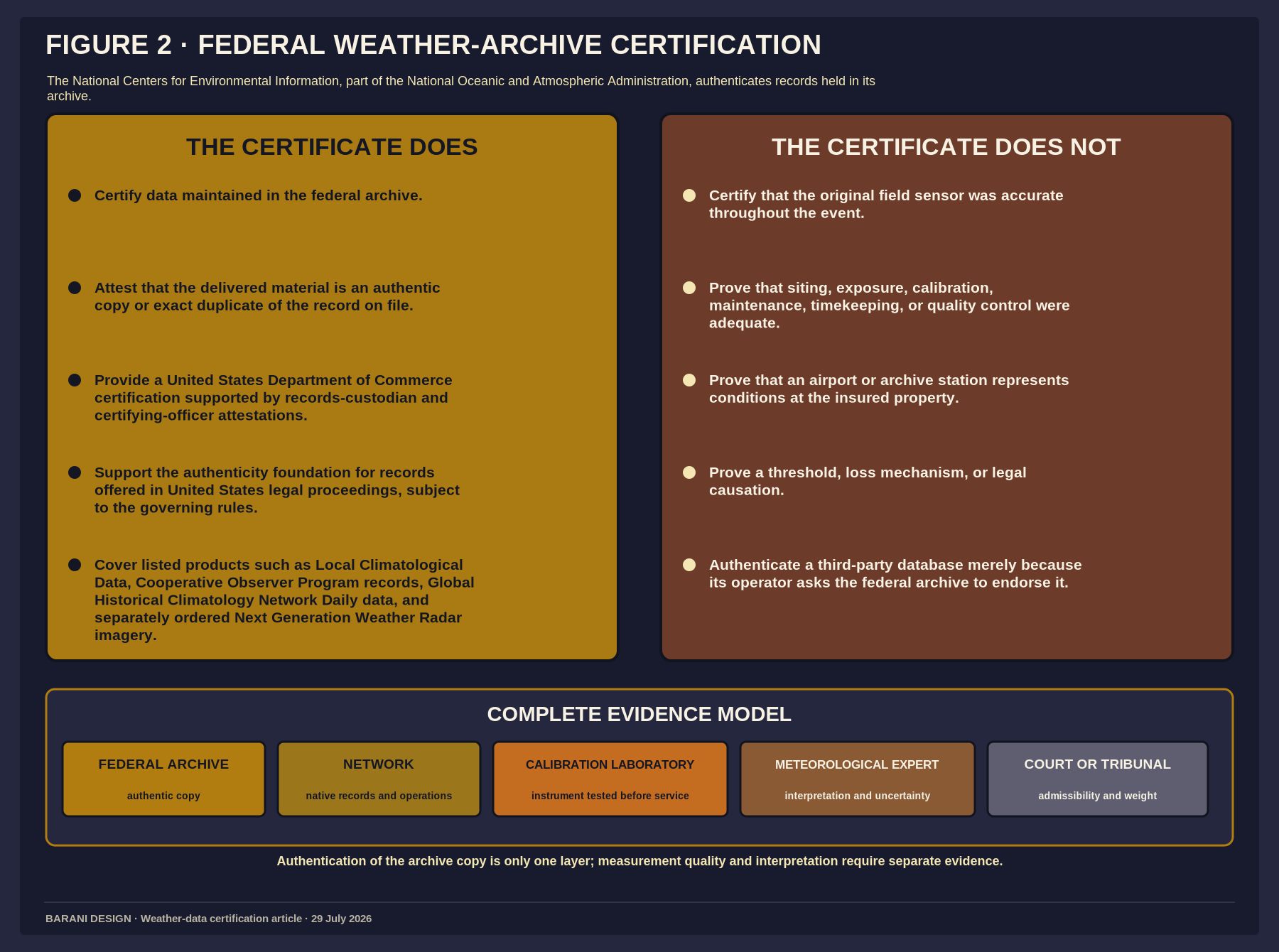
The National Centers for Environmental Information (NCEI) is the federal archive-authentication layer. The Department of Commerce states that it certifies data maintained in the NCEI archive to meet the authentication requirements for records submitted as evidence in court. Its sample certificate states that the attachments are authentic and true copies of meteorological records on file at NCEI and carries both a records-custodian attestation and a Department of Commerce certifying-officer seal.
The controlling limitation is equally important. National Weather Service Instruction 10-1003 states that NCEI certification attests only that exact duplicates of climatic records on file at NCEI were provided. The clean formulation is therefore:
NCEI certifies the archived record copy—not the weather measurement as a complete scientific or causal conclusion.
What an NCEI-certified record can establish
An NCEI certification can provide a strong authenticity foundation for a record that is actually maintained in the federal archive. In federal proceedings, a signed and sealed public document or a properly certified copy of a public record may fit the self-authentication routes in Federal Rule of Evidence 902(1) or 902(4), subject to the case, the document, and the court’s procedure. Authentication reduces the need to call an NCEI custodian merely to prove that the document came from the archive.
It does not automatically decide relevance, completeness, hearsay, scientific reliability, station representativeness, or causation. Those remain separate questions.
What NCEI certification does not establish
By itself, an NCEI certificate does not prove that:
- the original sensor was accurate throughout the disputed event;
- the instrument met a World Meteorological Organization, National Weather Service, Environmental Protection Agency, or other performance requirement in its deployed condition;
- the station was correctly exposed or representative of the insured property;
- the instrument remained within calibration;
- a particular threshold was exceeded at a different location;
- the weather caused the claimed damage; or
- the chosen dataset version, reporting day, aggregation, or derived variable is the correct one for the legal question.
Which NCEI products can be ordered as certified records?
As verified on 29 July 2026, NCEI’s online certification page lists:
- Local Climatological Data;
- Edited Local Climatological Data;
- Record of Climatological Observations from the Cooperative Observer Program; and
- Global Historical Climatology Network Daily.
NCEI also certifies customized color hard copies of Next Generation Weather Radar Level II and Level III images through an offline order. Its land-based-station guidance further notes that other orderable data products may be certified by contacting NCEI even when they are not offered through the online certification workflow. The exact station, product, period, format, delivery method, current fee, and certification availability should be checked before ordering; NCEI specifically instructs users to inspect the required data before placing a certified-copy order.
NCEI and a dense mesonet are usually complementary
An NCEI station may be farther from the loss site, located at an airport with materially different exposure, or available only at an hourly or daily resolution. A nearby five-minute mesonet can better resolve a short convective downpour, local wind maximum, frost pocket, hail core, urban heat effect, road-surface condition, or agricultural microclimate.
The strongest disputed-claim packet may therefore contain both:
- an NCEI-certified federal record as independent official archive evidence; and
- a local mesonet record packet with native-resolution files, hashes, historical metadata, quality-control flags, station photographs, calibration and maintenance records, and any as-found verification.
A qualified meteorological expert can then explain why the records agree, differ, or answer different questions.
Can NCEI certify a state mesonet’s or private network’s database?
Not merely because the operator asks NCEI to endorse a file. NCEI can certify a record that NCEI maintains in its own archive. NCEI does receive data from researchers, government organizations, and institutions worldwide, and data not produced by the National Oceanic and Atmospheric Administration may be considered through a formal scientific-appraisal and archive-submission process. First-time submitters are directed to consult an NCEI archive specialist.
If a mesonet product is formally accepted and maintained as an NCEI holding, NCEI may authenticate the archived copy. That still does not make NCEI the original operator, retroactively validate every field measurement, or replace the operator’s native high-frequency data, instrument serial numbers, maintenance history, software and configuration records, or event-period evidence.
Why dataset identity and version matter
“National Oceanic and Atmospheric Administration data” is not a sufficiently precise exhibit description. For example, Global Historical Climatology Network Daily integrates daily records from many sources, applies common quality checks, receives daily updates, is reconstructed weekly from more than 25 source components, and assigns unique archived version numbers. Real-time data streams may later be replaced by archive-ready sources.
A legal packet should therefore identify:
- dataset and product name;
- station identifier;
- NCEI order number and certification date;
- product or dataset version where available;
- source, measurement, and quality-control flags;
- units and aggregation interval;
- time zone and reporting-day boundary;
- preliminary, final, corrected, or archive-ready status; and
- the documentation applicable to that version.
For precipitation in particular, a daily value is incomplete without its accumulation boundary. Local midnight-to-midnight, observer morning-to-morning, and Coordinated Universal Time-based totals can answer different questions.
How NCEI figures internationally
NCEI operates World Data Centers and Services and maintains global environmental holdings. Global Historical Climatology Network Daily, for example, contains records from more than 100,000 stations in 180 countries and territories, with source data supplied through national meteorological and hydrological services, bilateral arrangements, and other archives.
NCEI may therefore hold and certify an orderable archive product for a station outside the United States. Such a certificate establishes that the delivered material is an authentic copy of the NCEI holding. It does not necessarily establish that the copy is the originating country’s complete or legally designated record, that all local metadata accompanied the international exchange, or that a foreign tribunal must accept the United States certificate without further formalities.
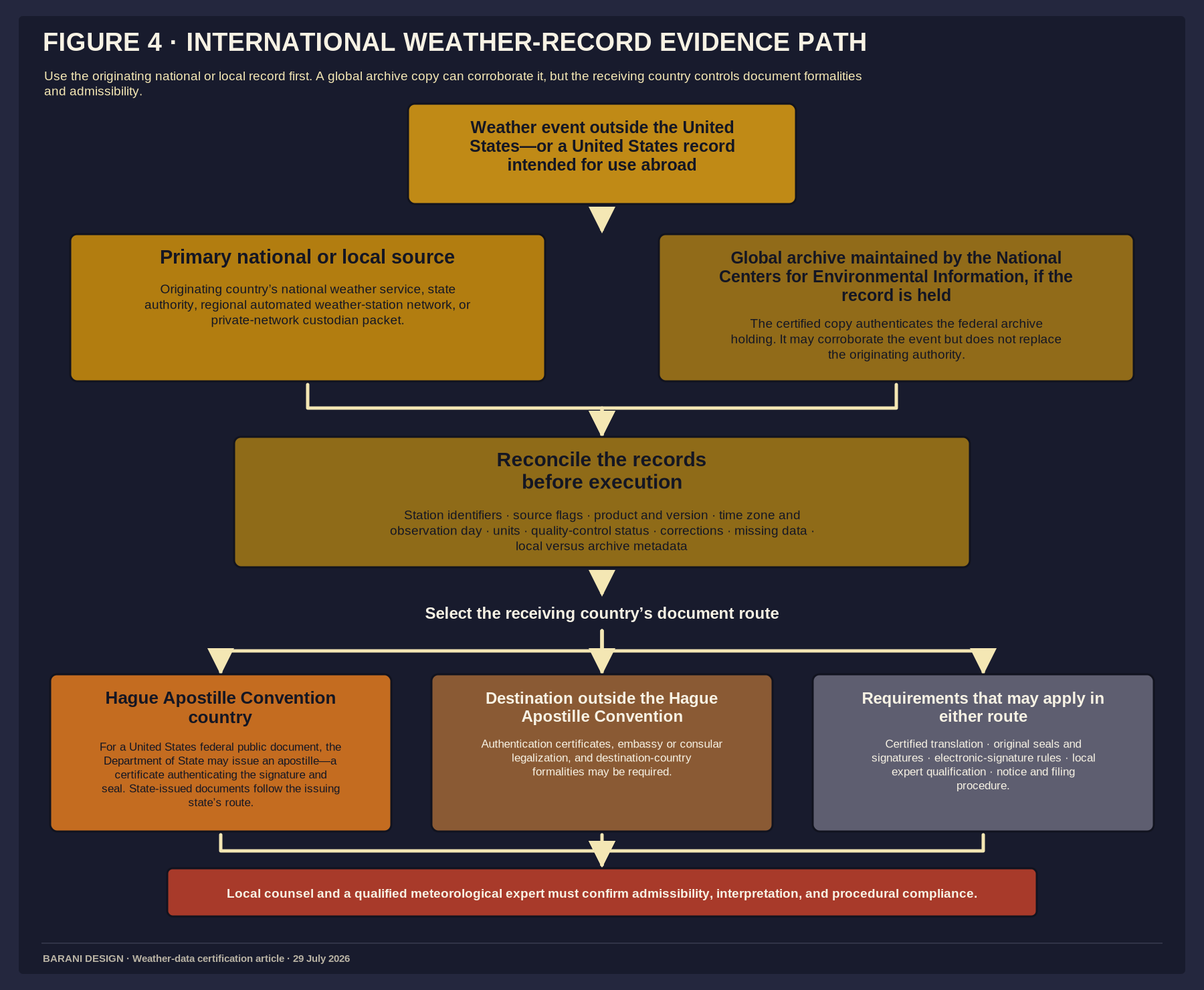
For a weather event outside the United States, the preferred hierarchy is normally:
- obtain the official or certified record from the originating country’s National Meteorological and Hydrological Service where available;
- obtain the native record and custodian packet from any local mesonet or private network supplying the closest or highest-resolution evidence;
- use the NCEI global archive copy as independent corroboration or archival fallback;
- reconcile source, station identity, reporting period, units, flags, corrections, and version; and
- complete the receiving country’s translation, apostille, authentication, legalization, expert, and filing requirements.
For a United States federal public document used in a Hague Apostille Convention country, the United States Department of State explains that an apostille may be required. Non-Hague destinations may require an authentication certificate and additional legalization. The receiving authority and local counsel should determine the exact route before the record is ordered and executed.
Division of responsibility
| Evidentiary question | Best source |
|---|---|
| Is this an authentic copy of a record maintained in the federal archive? | National Centers for Environmental Information / Department of Commerce certification |
| Is this an authentic native record produced by a mesonet or private network? | Network records custodian or another qualified records witness |
| How was the station operated, configured, maintained, calibrated, and quality controlled? | Network technical records and technical witness |
| How did the recovered instrument perform in its field condition? | Independent laboratory, with as-found testing before cleaning or adjustment |
| What does the observation mean at the disputed place and time? | American Meteorological Society Certified Consulting Meteorologist or another qualified forensic meteorologist |
| Is the evidence admissible, and how much weight should it receive? | The court, agency, arbitrator, or other deciding authority |
The practical rule is simple: use the federal archive to authenticate its own holding, the network custodian to authenticate the network holding, the laboratory to test the instrument, and the meteorological expert to interpret the event.
7. Does designation as an “official source” solve the problem?
A statute, regulation, executive designation, university authority, or recognized state-climatologist role can strengthen the signer’s institutional authority. It does not automatically prove that a particular station was correctly sited, that its sensor remained within tolerance, that a file was not altered, or that the station represents the incident location. Treat official status as one layer of the foundation, not the entire foundation.
Where an official-source designation exists, identify the exact statute, regulation, order, policy, or delegation; its effective date; and the records or functions it covers. A designation limited to issuing climatological observations should not be presented as authority to certify causation, site representativeness, instrument condition, or legal admissibility.
8. Is “World Meteorological Organization certified,” “National Weather Service compliant,” or “Environmental Protection Agency approved” a safe description?
Usually not without a specific, verifiable certification program and scope. The World Meteorological Organization Guide to Instruments and Methods of Observation (WMO-No. 8) is a guide covering measurement methods, automatic weather stations, sampling, data reduction, quality management, testing, calibration, and intercomparison. National Weather Service and Environmental Protection Agency requirements commonly involve the complete observing system: siting, exposure, averaging, logging, calibration, maintenance, quality control, and reporting. A sensor specification may conform to a performance recommendation while the installed station does not satisfy all system-level requirements.
Use narrower language, such as:
“The manufacturer declares that the instrument’s specified measurement performance is designed to meet the cited requirements under the stated conditions. Compliance of the deployed observing system also depends on siting, exposure, installation, data processing, calibration, maintenance, and the governing program.”
Do not use the phrase “World Meteorological Organization certified” unless a genuine certificate, issuing body, scope, edition, and applicable product are identified.
9. What is the minimum defensible data package?
At minimum, provide:
- a request and scope sheet identifying the matter, station, variables, date-time range, time zone, and intended recipient;
- a signed certificate by the records custodian or another qualified person;
- the native or least-transformed data extract;
- a human-readable presentation copy, if useful;
- a signed attachment manifest listing every file, byte size, and SHA-256 hash;
- a data dictionary defining variables, units, interval semantics, missing values, and flags;
- a station metadata snapshot valid for the requested period;
- a disclosure of data status: raw, provisional, quality-control reviewed, corrected, or final;
- a transformation log for unit conversions, aggregation, rounding, filtering, and derived variables; and
- known limitations, gaps, outages, maintenance events, and relevant quality-control flags.
A stronger technical packet adds calibration certificates, maintenance history, site photographs, siting classification, firmware and software versions, logger configuration, time-source records, and change history.
The downloadable Word template above turns this list into a records-custodian affidavit plus six structured schedules, so the signer does not have to force every technical fact into one long narrative paragraph.
10. Why include hashes if the certificate is signed?
A signature identifies an attestation; a cryptographic hash identifies the exact bytes covered by it. A 256-bit Secure Hash Algorithm (SHA-256) value lets the recipient verify that any delivered data or document file has not changed since the manifest was signed, regardless of whether the file is a comma-separated values table, a Portable Document Format document, a Network Common Data Form dataset, a JavaScript Object Notation file, or another format. Hash the source extract and every delivered derivative. If a file is regenerated, assign a new package version and new hashes rather than overwriting the original.
A hash does not prove the source observation was correct. It proves integrity from the identified point in the evidence workflow.
11. Should the operator provide raw, provisional, or final data?
The answer should be explicit, not implicit. Preserve the original acquisition record and disclose every later state. A sensible hierarchy is:
- raw/acquired: as received from the station or gateway;
- operational/provisional: available in near-real time and subject to later review;
- quality-control reviewed: evaluated under a documented quality-control procedure and version;
- corrected/reprocessed: changed under a documented rule, with original retained; and
- final/released: the network’s designated archival product.
Do not silently substitute a reprocessed series for the data available at the event time. Provide a change log that shows why values changed and which version the opinion uses.
12. How should time be documented?
State all of the following:
- station clock source and synchronization method;
- storage time zone, preferably Coordinated Universal Time;
- local civil time and its offset from Coordinated Universal Time for the event;
- daylight-saving-time treatment;
- observation timestamp meaning—instantaneous, beginning of interval, end of interval, or centered interval;
- accumulation boundary for precipitation, snow, energy, or daily statistics;
- gust averaging duration and sampling method; and
- any known clock correction, drift, communication delay, or retrospective timestamp repair.
“Five-minute data” is incomplete unless the operator explains what the timestamp and value represent.
13. How should derived variables and unit conversions be handled?
Separate directly measured variables from calculated variables. For each calculation, identify the input fields, equation or named method, software version, constants, unit conversion, rounding rule, and treatment of missing or flagged inputs. Preserve the original units. A custodian may authenticate a generated report, but an expert may be required to defend the scientific method behind dew point, heat index, wind chill, evapotranspiration, return period, or other derived conclusions.
14. What station metadata matter most?
The period-specific snapshot should include network and station identifiers, coordinates, elevation, installation and removal dates, surroundings, sensor heights, boom orientation, mast or roof configuration, shielding or aspiration, precipitation-gauge geometry and level, nearby obstructions, land cover, instrument manufacturer/model/serial number, logger and communications hardware, firmware/configuration versions, and photographs near the event date.
Metadata must be historical. A current station page does not prove the configuration in effect years earlier.
15. What quality-control records should be preserved?
Preserve the quality-control specification and version, each flag attached to the requested observations, automated test outcomes, manual-review records, neighbor or buddy checks, range and step tests, persistence tests, internal diagnostics, maintenance tickets, corrections, rejected values, and release decisions. Explain whether flags warn, replace, suppress, or merely annotate a value.
Environmental Protection Agency meteorological-monitoring guidance describes a defensible quality-control program as including periodic calibration, site inspections, data screening, validation, and preventive maintenance, with quantitative documentation supporting accuracy claims. That is a useful general evidence principle even when the particular network is not an Environmental Protection Agency regulatory monitor.
16. When should the instrument be preserved for as-found verification?
Preserve hardware when instrument performance is genuinely disputed, the potential loss is material, a regulator or contract requires it, a preservation demand has been received, or later testing would likely affect settlement or testimony. Issue a written hold before routine maintenance destroys the evidence.
The hold should cover the sensor, shield, gauge body, moving parts, logger, wiring, power system, mounting hardware, memory, configuration, field photographs, maintenance records, raw data, diagnostics, and software logs. The exact scope depends on the variable and theory of failure.
17. What does “as-found, uncleaned” mean?
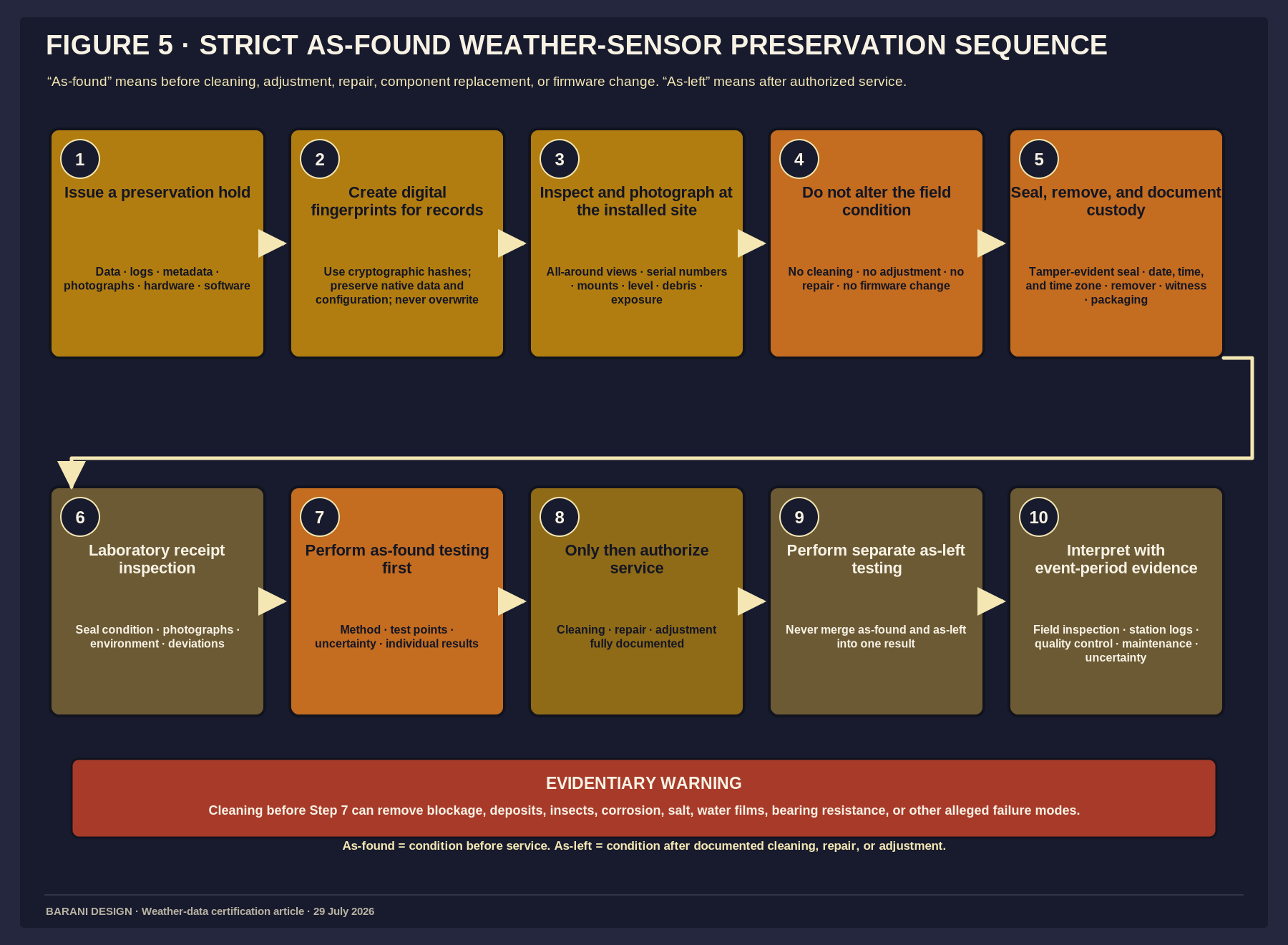
It means the item is characterized and tested before cleaning, adjustment, repair, component replacement, firmware change, seal replacement, lubrication, drying, or other intervention that can change its response. National Institute of Standards and Technology laboratory procedures use the same principle: when as-found data are needed, they are obtained before maintenance; a separate calibration after service produces the as-left result.
For environmental sensors, “uncleaned” does not mean unsafe handling or allowing the item to deteriorate. It means preserve and document the field condition, consult the laboratory before packaging, and perform only the stabilization or safety steps that are necessary and fully recorded.
18. Why is the as-found sequence so important?
Cleaning can remove the very contamination, deposits, insects, corrosion, salt, blockage, water film, or mechanical resistance alleged to have affected the measurement. Adjustment can erase drift. A new filter cap can change humidity response. Re-leveling can change a rain gauge. Lubrication can change anemometer starting threshold. If those actions occur before the initial test, the strictest evidence has been lost.
Report as-found and as-left separately. Never average or merge them into a single “calibration result.”
19. What can post-removal testing prove—and what can it not prove?
A competent as-found test can show how the recovered item performed under defined laboratory conditions at receipt. It can identify bias, hysteresis, response time, threshold, mechanical damage, contamination effects, or out-of-tolerance behavior within the test scope.
It cannot perfectly recreate the historical exposure, radiation shield, local airflow, icing, wetting, mast vibration, electrical noise, installation geometry, intermittent fault, or microclimate. Removal and transport can change leveling, debris distribution, moisture, bearings, connectors, and soil contact. Therefore, field inspection and photographs should precede removal, and the expert should treat the laboratory result as one line of evidence rather than a time machine.
20. What laboratory should be used?
Use a laboratory competent for the actual measurand, range, method, and item. ISO/IEC 17025—the competence standard issued by the International Organization for Standardization and the International Electrotechnical Commission—applies to testing and calibration laboratories. For cross-border acceptance, confirm that the accreditation body participates in the International Laboratory Accreditation Cooperation Mutual Recognition Arrangement and that the laboratory’s published scope covers the requested calibration or test. A generic accreditation logo is not enough.
The work order should require, where applicable:
- receipt photographs and seal condition;
- uncleaned as-found testing first;
- method, environmental conditions, reference standards, and uncertainty;
- traceability to the International System of Units and the calibration chain;
- decision rule for conformity statements;
- all individual results, not only pass/fail;
- separate as-left testing after authorized service; and
- retention or controlled return of the item and residues.
Metrological traceability is a property of a measurement result supported by a documented unbroken calibration chain, with each step contributing uncertainty. It is not a magic property conferred on every result because a laboratory once used a reference traceable to the National Institute of Standards and Technology.
21. Does an in-tolerance as-found calibration prove all historical data were correct?
No. It is favorable evidence, especially when combined with stable diagnostics, no relevant maintenance events, strong quality-control evidence, suitable siting, and consistent neighboring observations. But it does not exclude intermittent faults, event-specific icing, obstruction, representativeness errors, processing mistakes, or uncertainty outside the laboratory test points.
Conversely, an out-of-tolerance result does not automatically invalidate every observation. The expert must consider direction and magnitude of bias, measurand and range, uncertainty, failure mode, onset timing, corroborating data, and whether the disputed conclusion would change.
22. Why can low-maintenance design reduce evidentiary risk?
Every cleaning, filter change, re-leveling, bearing service, cup replacement, field adjustment, firmware update, and manual intervention creates a potential configuration discontinuity and a recordkeeping obligation. Designs that remain cleaner, resist corrosion or water, preserve alignment, reduce wear, or permit controlled component replacement can reduce the number of unexplained changes between calibration and event.
The defensible claim is not that low-maintenance equipment is infallible. It is that reduced intervention and improved resistance to field contamination can make the chain between specified performance, actual field condition, and independent as-found verification shorter and easier to document.
23. How do BARANI instruments fit this evidence-readiness model?
BARANI product documentation emphasizes field stability, contamination resistance, low power consumption, serviceable measurement components, and open data interfaces. In the formal product names, Internet of Things (IoT) identifies wireless connected versions. These are engineering and lifecycle features—not legal certifications—and they do not replace event-period records or independent verification. Their potential evidentiary value is that they can reduce the number of maintenance interventions and configuration changes that must later be explained, while making serial-controlled replacement, recalibration, data reconstruction, and as-found inspection easier.
Manufacturer disclosure. BARANI DESIGN manufactures the products discussed below. The table therefore separates manufacturer-described design features from the potential evidentiary advantage of those features and from the case-specific evidence that an operator must still preserve.
| Product family | Manufacturer-described field design | Potential evidentiary advantage | Evidence still required |
|---|---|---|---|
| MeteoHelix IoT Pro Wireless micro-weather station built around the MeteoShield helical radiation shield |
The measurement head is installed inside a helical radiation shield designed to shed water, direct dirt and spray away from the sensing area, and maintain passive ventilation. BARANI cites an independent long-term intercomparison by the Royal Meteorological Institute of Belgium for the underlying MeteoShield design. A field-replaceable sensor head supports controlled recalibration, independent verification, or replacement without changing the complete station. | Reduced fouling and fewer cleaning interventions can reduce undocumented changes between calibration and the disputed event. A serial-controlled head exchange can limit the data gap, preserve continuity under a service-level availability commitment, and allow the removed head and shield to be documented separately in their as-found condition. | Station and sensor-head serial numbers; event-period siting and shield condition; replacement, calibration, verification, and downtime records; firmware and message-decoder versions; radiation, airflow, wetting, icing, outage, and quality-control context. |
| MeteoRain Wired and wireless aerodynamic rain gauges in the MeteoRain 200, 400, and 533 product families |
Aerodynamic collector geometry is intended to reduce wind-related catch disturbance and splash, while the self-balancing magnetic tipping mechanism is intended to reduce sensitivity to dirt, vibration, residual water, and small leveling errors. BARANI documentation also describes shaded wetted surfaces and low-thermal-effusivity materials intended to reduce solar-driven evaporation. Field-serviceable measuring components support controlled replacement and recalibration; applicable wireless models use documented, firmware-specific high-rain-rate compensation. | Reduced catch sensitivity and fewer cleaning or leveling interventions can limit unexplained changes in the measurement chain. The inlet, funnel, and tipping mechanism remain directly inspectable in the uncleaned as-found condition. Native tip records and preserved compensation settings can help distinguish mechanical response from later software processing. | Exact model, collector area, and tip resolution; inlet and funnel condition; level; insects, leaves, and other obstruction; wind exposure; volumetric or gravimetric verification; tip timing; compensation algorithm and firmware; accumulation boundary; heater or freezing status; evaporation and wind-undercatch limitations; logger and decoder history. |
| MeteoWind Wired and wireless cup anemometers and wind-direction sensors |
Applicable models use all-metal construction, flat elliptical cups, replaceable cups and oversized bearings, and solid-state speed sensing. These features are intended to provide high aerodynamic torque, low starting speed, linear response, snow shedding, and resistance to dirt and wear. BARANI describes applicable models as meeting the cited wind-measurement requirements of the World Meteorological Organization, the United States Environmental Protection Agency, and the International Network of Wind Energy Measurement Organizations, commonly known as MEASNET. | Long service intervals can reduce cup, bearing, and geometry changes. Stable mechanical geometry and a low starting threshold support continuity in low-wind and gust measurements. When service is necessary, replaceable parts allow the operator to preserve separate as-found and as-left inspection and test records. | Mast and exposure; mounting height, boom geometry, and orientation; cup, vane, shaft, and bearing condition; starting threshold and calibration curve; icing and heater status; sampling frequency; scalar or vector processing; gust duration and algorithm; logger, firmware, and decoder versions. |
| MeteoTemp Wired temperature, relative-humidity, and optional pressure probes |
Ultra-low-power electronics are intended to reduce electrical self-heating. A replaceable microporous polytetrafluoroethylene filter cap and hydrophobic body protect the sensing elements and support controlled filter service. The probe architecture also supports recalibration and retention of calibration coefficients for traceability. | Lower self-heating risk is especially relevant in weak airflow. Reduced water and contamination exposure, together with separately documented filter or probe service and retained calibration coefficients, can produce a clearer measurement history than undocumented cleaning or replacement of an integrated assembly. | Radiation shield or aspiration; power supply and duty cycle; filter and service history; probe serial number; stored calibration coefficients; relative-humidity drift and hysteresis; condensation and wetting exposure; calibration range, points, and uncertainty; communication register map and firmware version. |
| MeteoAG Wireless sensor node for external agricultural, environmental, and compatible heat-stress sensors |
The solar-powered plug-and-play node connects up to seven external sensors and uses a published open message format. Documented arrangements include soil moisture, soil-water tension, soil temperature, and leaf wetness; compatible, identified sensors can also be arranged for multi-height temperature or heat-stress measurements. | Modular channels make complex installations easier to identify, replace, and service. Open native messages allow an independent party to reconstruct decoded values, while one node can preserve common timing, channel identity, and transmission history for several connected sensors. | External sensor model, serial number, and calibration; channel-to-sensor mapping; installation depth, height, and location; wiring and connector changes; sampling and transmission interval; clock and battery status; native payloads; decoder, firmware, and configuration versions. |
Evidence boundary. These features reduce evidentiary risk only when the operator preserves the whole measurement chain: the applicable product specification, serial numbers, installation photographs, station and channel configuration, calibration and maintenance records, native messages, firmware and decoder versions, quality-control history, outage and replacement logs, and—when hardware is disputed—the uncleaned as-found condition. Manufacturer documentation supports the design description; the network’s period-specific records support the case.
24. Is it fair to say the rest of the industry focuses only on clean-state laboratory accuracy?
That would be too broad. Many manufacturers and networks perform excellent field validation, intercomparison, preventive maintenance, and lifecycle testing. The narrower and supportable industry observation is that published datasheets usually state accuracy under controlled conditions, while a legal dispute concerns performance after real field exposure. Network procurement should therefore evaluate both clean-state specification and field-state evidence readiness: contamination resistance, drift, response, maintainability, intervention frequency, diagnostics, component identity, and the feasibility of independent as-found testing.
25. When is an expert meteorologist needed?
Use an expert when the dispute moves beyond “is this an authentic record?” to questions such as:
- whether the station represents the incident location;
- whether nearby stations, radar, satellite, lightning, road, hydrologic, or eyewitness evidence should be reconciled;
- whether the sampling interval could miss a gust or convective rainfall maximum;
- whether siting, shielding, wind undercatch, icing, wetting, evaporation, or urban effects matter;
- how measurement uncertainty affects a threshold or policy condition;
- whether a calculated variable or return-period analysis is valid; or
- whether weather caused or merely coincided with the claimed loss.
The records witness should not be stretched into giving causation opinions outside that person’s expertise. In United States federal court, expert testimony is governed by Rule 702 and associated disclosure and procedure.
26. Where can a mesonet, insurer, or attorney find an American Meteorological Society Certified Consulting Meteorologist?
A practical division of responsibility is for the network to issue and authenticate its own records, while an independent American Meteorological Society Certified Consulting Meteorologist addresses interpretation, representativeness, uncertainty, reconstruction, and—when qualified for the assignment—expert testimony. The American Meteorological Society describes holders of this certification as consultants held to standards of technical competence, character, and experience and specifically identifies expert testimony in weather-related court cases as an application of the credential.
This expert layer does not replace the records-custodian certificate. The custodian authenticates the network record and explains the ordinary data system; the expert interprets the evidence and offers opinions within a disclosed scope.
Interactive 50-state directory
In the published article, Figure 3 uses a standard Hypertext Markup Language image map: click or tap any state rectangle to open the corresponding American Meteorological Society Weather and Climate Service Providers Directory page. On a narrow screen, scroll horizontally across the fixed-size image so the smallest rectangles remain readable and tappable. A downloaded or image-search copy is not interactive, so the standalone graphic also prints the state-page address pattern.
Interactive figure: select or tab to any state rectangle to open that state’s American Meteorological Society directory page in a new tab. On a narrow screen, scroll horizontally to reach every state.
If a state link does not open in the editor, preview the page in Safe Mode or use the American Meteorological Society Weather and Climate Service Providers Directory. No separate image upload or image-address replacement is required for this figure.
What the tile size means—and does not mean
The American Meteorological Society certification-holder page displayed 229 active Certified Consulting Meteorologists on 28 July 2026. The treemap does not claim to allocate all 229 by state. Its size metric is the 65 individual contacts directly listed by state on the public Association of Certified Meteorologists roster, because that source is auditable and state-indexed. Every tile then links to the broader American Meteorological Society Weather & Climate Service Providers Directory, which may contain additional individuals and companies and changes over time.
A count of 0 therefore means only “not listed in the conservative count source used for this snapshot.” It does not mean that no active Certified Consulting Meteorologist resides in or serves that state. The Association of Certified Meteorologists roster also notes that most experts can handle assignments nationwide, so the incident state is a starting point—not a geographic restriction.
The Association of Certified Meteorologists page repeats a New Mexico heading above Elizabeth Austin and Gary Ellrod; their detailed entries place them in Reno, Nevada. This directory therefore counts those two contacts under Nevada rather than under New Mexico. The dated snapshot counts those two contacts under Nevada rather than New Mexico, based on the locations stated in their detailed entries.
Expert-selection checklist
Before engagement, confirm:
- active American Meteorological Society Certified Consulting Meteorologist status on the official certification-holder list;
- relevant specialty, including forensic meteorology, instrumentation and measurements, radar, precipitation, wind, icing, agriculture, air quality, or another case-specific field;
- conflicts, independence, geographic and temporal availability, and any court-specific qualification or disclosure requirements;
- experience with mesonet metadata, automated quality control, calibration, as-found testing, uncertainty, and chain-of-custody evidence;
- the exact opinion scope, source materials, methods, assumptions, limitations, retention duties, and fee structure; and
- whether the expert is expected to consult, write a report, give a deposition, testify, or merely help counsel understand the data.
The expert should receive the exact certified data package—not an informal spreadsheet detached from its manifest—including native files, hashes, station history, sensor identity, timebase, quality control flags, maintenance and calibration records, site photographs, transformations, known limitations, and any as-found laboratory evidence.
27. How can the package be used internationally?
Use a two-part structure:
- a stable factual certificate describing the organization, record system, files, integrity controls, station, measurements, and limitations; and
- a replaceable jurisdiction rider selected for the receiving court, agency, insurer, or country.
The rider may require a sworn affidavit, an unsworn declaration, consular legalization, an apostille, a certified translation, a qualified electronic signature, a qualified electronic time stamp, or a locally licensed expert. An apostille authenticates the signature, capacity, and seal; it does not validate the scientific truth of the contents. For the European Union, the electronic identification, authentication, and trust services regulation provides that an electronic signature is not denied legal effect solely because it is electronic and gives a qualified electronic signature the legal effect of a handwritten signature, but national procedural rules still govern admissibility and proof.
28. Should a mesonet or sensor network charge a fee for certified records?
There is no evidentiary rule that makes a paid certificate stronger than a no-fee certificate. The correct operating model depends on public mission, request volume, staff time, institutional accounting requirements, and whether the request is a standard records package or a complex technical assignment.
A no-fee public-service model can be practical when request volume is low and the operator can issue a standardized packet with little special programming. In that situation, collecting and accounting for a small commercial fee may consume more staff time than the certification itself. Higher-volume, expedited, custom, or technically complex requests may justify cost recovery or a hybrid model. The financial model is administrative; it does not make the evidence stronger or weaker.
| Operating model | When it can work well | Safeguards to publish |
|---|---|---|
| No-fee public service | Low request volume, clear public-service mission, standardized packet | Scope, normal turnaround, authorized signer, retained copy, limits on interpretation and testimony |
| Cost recovery | Higher volume, extensive retrieval, special programming, notarization, media, or expedited handling | Public fee schedule, deposit rules, cancellation policy, separate charges for records and expert work |
| Hybrid | Basic authenticated packet is routine, but technical dossiers, preservation, or expedited work consume substantial resources | Define what is free and what is billable; never condition factual wording on payment |
| Referral-only | The institution lacks authority, staffing, or appetite to certify | Provide ordinary data and metadata, identify the correct federal archive or independent meteorological expert, and avoid implying certification |
A no-fee service still needs the same controls: unique request identifier, defined scope, reproducible export, signed certificate, attachment manifest, cryptographic file hashes, retained evidence copy, and documented limitations. Conversely, a fee must never purchase favorable wording, suppress adverse quality flags, or convert a records witness into a paid causation expert. Record-production charges and expert-consulting charges should be separated.
International execution map
The scientific core can remain stable, but the execution and document-authentication route must be selected for the receiving country and proceeding.
Recommended evidence service levels for a mesonet
| Level | Intended use | Package | Operator commitment |
|---|---|---|---|
| 0 — Informational extract | Research, planning, routine customer inquiry | Data and ordinary metadata; clearly marked non-certified | Standard portal terms and reproducible export |
| 1 — Authenticated record packet | Routine insurer or legal request where authenticity is the main issue | Custodian certificate, extract, data dictionary, manifest, hashes | Controlled request, review, signature, retention copy |
| 2 — Technical foundation packet | Material claim or expected challenge to quality | Level 1 plus historical station dossier, quality control, maintenance, calibration, photos, software/timebase | Technical review and documented limitations |
| 3 — Preserved-instrument packet | Instrument performance is disputed | Level 2 plus legal hold, in-situ inspection, removal record, custody, independent as-found/as-left report | No cleaning or alteration before authorized testing |
| 4 — Expert litigation packet | Representativeness, thresholds, uncertainty, or causation disputed | Level 3 as relevant plus expert analysis, alternative evidence, disclosures, demonstratives | Separation of custodian, lab, and expert roles |
The network should publish its fee policy—including a no-fee public-service option where applicable—together with response times, retained-copy period, witness availability, preservation charges, and the point at which the request is referred to counsel or an independent expert.
Strict as-found preservation and verification map
The sequence is intentionally conservative because cleaning, adjustment, repair, or component replacement can destroy the alleged failure mode.
Cross-examination readiness
A defensible network prepares before a subpoena. The goal is not to script evasive answers. It is to make truthful answers short, exact, documented, and within each witness’s role.
The questions a records witness should expect
| Likely challenge | Evidence to have ready | Proper boundary |
|---|---|---|
| “Who authorized you to certify this?” | Job description, delegation, records policy, statute or institutional authority | Authenticate only records and processes within personal knowledge |
| “Was this report created for litigation?” | Show that underlying observations were created contemporaneously in ordinary operations; distinguish later export | Do not claim the export itself existed at event time if it did not |
| “How do we know this file was not edited?” | Native source, export log, signed manifest, SHA-256 file hash, retained evidence copy | A hash begins proving integrity only from its recorded creation point |
| “Is this the raw data?” | Data-state definition, version history, original acquisition files, quality-control and correction log | State exactly which product is attached |
| “What do the flags mean?” | quality control specification/version and observation-level flags | Do not imply that a pass flag proves zero error |
| “What does the timestamp mean?” | Coordinated Universal Time and local-time conversion, interval convention, clock-source logs | Avoid guessing from a displayed local-time label |
| “Was the sensor calibrated?” | Certificates, scope, due dates, acceptance criteria, as-found/as-left history | Distinguish pre-deployment calibration from event-period performance |
| “Was the station maintained or cleaned?” | Work orders, before/after photos, replaced serials, configuration change log | Disclose relevant interventions, including unfavorable ones |
| “Is it World Meteorological Organization certified?” | Exact manufacturer statement, cited requirement, system-level assessment | Do not convert conformance language into a nonexistent certification |
| “Does this station prove weather at the insured property?” | Distance, elevation, exposure, representativeness analysis, corroborating data | This is generally an expert issue, not a records-custodian conclusion |
| “What is the uncertainty?” | Calibration uncertainty, specified accuracy, field effects, processing and representativeness | Do not present a single number unless its scope and method are defensible |
| “Why was the instrument cleaned before testing?” | Preservation protocol and custody record—or candidly identify the gap | Never conceal spoliation or an avoidable evidence loss |
The questions a technical or expert witness should expect
- What opinion are you actually offering, and what are you not offering?
- Which data version, station configuration, and time convention did you use?
- What independent evidence supports or conflicts with the mesonet observation?
- What are the material uncertainty components and how could they affect the conclusion?
- Is the station representative of the incident site, variable, height, and averaging interval?
- Were there obstructions, terrain, urban, coastal, canopy, roof, icing, wetting, undercatch, or maintenance effects?
- Could the sampling and aggregation method miss the alleged gust, rainfall intensity, or temperature extreme?
- Were any unfavorable values, flags, outages, changes, or alternative explanations omitted?
- What does the as-found test show within its scope, and what historical conditions can it not reconstruct?
- Would a reasonable change in assumptions alter the threshold, classification, or causation opinion?
Four phrases that should be removed from templates
| Avoid | Use instead |
|---|---|
| “The data are accurate.” | “The attached files are authentic copies of the identified records; measurement quality and limitations are described in the attached technical documentation.” |
| “The station is World Meteorological Organization certified.” | “The cited component specification is declared to conform to the identified requirement under stated conditions; installed-system conformity is addressed separately.” |
| “The notary certifies the mesonet.” | “The notary administers the oath or acknowledges the signer, as applicable.” |
| “The calibration proves the sensor was correct during the event.” | “The as-found result characterizes the recovered item under the stated test conditions and is evaluated together with event-period records.” |
Standing policy for network operators
Every mesonet or sensor network should adopt a written Weather Data Evidence Policy before the first contentious request. The policy should designate authorized records witnesses; define data products and retention; require reproducible exports and hashes; preserve historical metadata, algorithms, calibration, and maintenance; specify legal-hold and hardware-preservation triggers; separate factual certification from expert opinion; identify approved laboratories and experts without guaranteeing their conclusions; define the no-fee, cost-recovery, hybrid, or referral policy and response times; and require legal review of jurisdiction-specific execution blocks.
The policy should also state that routine maintenance stops once a preservation hold applies. For a rain gauge, “routine cleaning” may destroy the evidence of blockage. For a humidity probe, changing a filter may remove contamination. For an anemometer, replacing cups or bearings may erase the failure mode. The preservation decision must occur before the technician arrives with tools.
Publication conclusion
The strongest weather-data evidence is not a more emphatic affidavit. It is a transparent chain from sensor and site to stored record, from stored record to hashed extract, from field condition to independent as-found verification where needed, and from observation to a properly bounded expert opinion.
Low-maintenance sensors can materially improve that chain by reducing the number of undocumented interventions and by preserving a field condition closer to the instrument’s stable operating state. BARANI’s MeteoHelix, MeteoRain, MeteoWind, MeteoTemp, and MeteoAG families are appropriately positioned around that lifecycle advantage—provided the operator still documents the complete observing system and avoids overstating component specifications as blanket legal or standards certification.
Official references and further reading
Federal Rules of Evidence, especially Rules 702, 803(6), 901, 902(1), 902(4), 902(11)–(14), 1001–1003 and 1006. United States Courts. Open the official source
Section 1746 of title 28 of the United States Code — Unsworn declarations under penalty of perjury. United States House Office of the Law Revision Counsel. Open the official source
Data Certification. National Centers for Environmental Information, National Oceanic and Atmospheric Administration. Open the official source
Sample Department of Commerce certification for National Centers for Environmental Information records, Form CD-64. Open the official source
National Weather Service Instruction 10-1003 — Climate Data Services. Open the official source
National Weather Service Instruction 10-2005 — Handling Requests for Accident-Related Weather Information. Open the official source
National Centers for Environmental Information Archive and Submission Guidance. Open the official source
World Data System at the National Centers for Environmental Information. Open the official source
Global Historical Climatology Network Daily. Open the official source
Authentication and apostille guidance for United States federal documents. United States Department of State. Open the official source
ISO/IEC 17025:2017 — General requirements for the competence of testing and calibration laboratories. International Organization for Standardization and International Electrotechnical Commission. Open the official source
International Laboratory Accreditation Cooperation Mutual Recognition Arrangement and signatories. Open the official source
Metrological Traceability: Frequently Asked Questions and National Institute of Standards and Technology Policy. Open the official source
National Institute of Standards and Technology Standard Operating Procedure 26 (example of obtaining as-found data before maintenance and separate as-left calibration). Open the official source
World Meteorological Organization Guide to Instruments and Methods of Observation (WMO-No. 8). Open the official source
Meteorological Monitoring Guidance for Regulatory Modeling Applications. United States Environmental Protection Agency. Open the official source
European Union electronic identification, authentication, and trust services regulation, consolidated text. European Union law portal. Open the official source
BARANI product documentation: MeteoHelix, MeteoRain, MeteoWind, MeteoTemp, and MeteoAG.
American Meteorological Society Certified Consulting Meteorologist Program. Open the official source
American Meteorological Society list of Certified Consulting Meteorologists. Open the official source
Weather & Climate Service Providers Directory. American Meteorological Society. Open the official source
Find an Expert — List of Certified Consulting Meteorologists. Association of Certified Meteorologists. Open the official source
Publication scope and update note
This article synthesizes the official legal, archive, calibration, standards, and professional-directory sources listed above and applies them to weather-network records practice. The downloadable Microsoft Word document is a generic, jurisdiction-neutral drafting aid; it is not an official court, agency, archive, laboratory, insurer, or network form. The receiving lawyer or authority must confirm the current governing rule, required wording, notice, signature, notarization, electronic-signature, translation, apostille, authentication, legalization, and filing procedure. The Certified Consulting Meteorologist state graphic is a dated navigation aid rather than an official or live state census, and the live directory should always be checked before engagement. National Centers for Environmental Information product availability, fees, processing times, and delivery methods can change, so verify the current certification page before placing an order.